4 Dating Rules that You can Kiss Goodbye

Advice
  • Thursday, June 25 2015 @ 07:05 am
  • Contributed by:
  • Views: 1,441

If you’re single, chances are you’ve been given a lot of advice. The bigger question is – how much of it was actually helpful? Some people have good intentions, but if they haven't dated in twenty years, they could be giving outdated advice.

Instead of relying on the opinions of friends, family or even co-workers, it’s better to understand your own experiences and learn from them. Chances are, you’ve picked up a thing or two from the dates you’ve been on. The key question is – are you going to change your own behavior, or are you going to keep doing things the way you have been because those are the “rules” of dating?

Dating is changing all the time – thanks in large part to the accessibility of meeting other people through online dating services and apps. We no longer have to drag ourselves to a local bar to chat with someone – we can do it over our phones while binge-watching Real Housewives or standing in line at the grocery store. In fact, most dating-related conversations take place over the phone.

So what are some traditional dating “rules” you can kiss goodbye? Start here:

Letting the man ask you out.

It’s 2015, not 1952. Women and men compete for the same jobs and make decisions about what kind of life they want to lead. So why should dating be stuck back in the dark ages? Instead, ladies – it’s time to take some control and ask guys out. It’s incredibly easy to do with dating apps, and it’s no pressure.

Looking for romance over everything else.

I’m not saying romance is dead – in fact, it can be better than ever. But we need to recognize the difference between lust at first sight and real love. Attraction is great, but if someone sweeps you off your feet it doesn’t mean a lasting relationship – that is only built over time. So try to say yes to more second and third dates before you dismiss someone because of “lack of chemistry.” Chemistry grows stronger, too.

Letting the man take the lead.

Again, it’s 2015, so there’s no need to check yourself at the door and put your own needs on hold to wait for “cues” from your date about where the relationship will go. You have a say, too. Speak up. If you’re looking for long-term, don’t betray your own feelings by saying you’re fine with something more casual. You have an equal say in what you want, so make sure you take it.

Acting like you don’t care.

Playing the “cool girl” is not a path to success. Sooner or later your inner freak will come out, and that’s a good thing. Nobody is an emotionless void – we all have feelings and reactions, and it’s okay to show them. We’re not robots, and the more we embrace our feelings, the more intimate we can be in relationships.

Hinge CEO On The Benefits Of Online Dating

Hinge
  • Wednesday, June 24 2015 @ 06:37 am
  • Contributed by:
  • Views: 1,433

Everyone you know is talking about online dating. Most of them have tried it. You've thought about joining a site or downloading the latest app, but you're not quite convinced digital dating is for you.

Justin McLeod, CEO of Hinge, has something to say to you. A few somethings, in fact. He recently wrote a piece for Business Today on the benefits of online dating. If you've considered logging on for love but haven't taken the plunge yet, here's why you should.

  1. It's easy to get started. There's no excuse for not signing up when signing up is so easy. Socially-driven apps, like Hinge and Tinder, don't ask you to fill out a lengthy profile or answer an SAT exam-worthy series of questions. Instead they link directly to your Facebook account, automatically populating your dating profile with info from the social network. “This way,” McLeod writes, “interested people get to check out a bite-sized version of your personality without writing you off as not their type.
  2. Quality trumps quantity. Online dating offers a curated selection of potential dates, designed with your compatibility in mind. “Instead of having to wade through a sea of random profiles until you get lucky and find that elusive perfect someone,” says McLeod, “it can bring what you want to see.” And while a dating service is showing you people you're likely to be interested in, it's also filtering out the bad matches. The algorithms don't get it right every time, but it's still a perk that doesn't come with real-life romance.
  3. Conversation starters come standard. Say you meet someone on the street, or during your commute home from work. Starting a conversation can be difficult, not to mention intimidating, when you know nothing about each other. But online, where you have access to a profile and photos from a person's life, you have built-in subjects to spark a conversation. Find something that intrigues you and inquire about it.
  4. You're in control. No more waiting around for someone to approach you. No worries that a complex schedule will prevent you from meeting new people. No relying on a friend to arrange a blind date they promised to set up, and keep forgetting. Online dating lets you search for and communicate with potential dates any time, anywhere, with no reliance on third parties. “Moreover,” McLeod adds, “responses are generally quicker and easier to follow up on online.”

What are you waiting for? No more excuses.

Find Love In Your Browser With 'Tab'

Reviews
  • Tuesday, June 23 2015 @ 06:40 am
  • Contributed by:
  • Views: 1,400
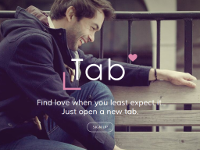
Tab Dating

Online dating sites have long wrestled with replicating the experience of dating in real life.

Offline, the love of your life may find you at any moment. You could be standing in the produce section of the grocery store, wondering how to tell if a cantaloupe is ripe, when suddenly an attractive stranger appears to help you pick. It's all about serendipity.

Online, dating feels calculated. You'll never randomly bump into The One. But if U.K.-based Tab has anything to say about it, serendipitous meetings could soon be a part of your digital dating life.

Tab isn't a dating website. It's not a trendy new mobile app. In fact, it's a browser extension for Chrome. Every time a user opens a new tab, they're shown a potential match. If they're not intrigued by what they see, they simply carry on with business as usual. If they do feel a spark, they click a heart button. Mutual “hearts” are connected.

"Imagine you could bump into the love of your life on any corner of the Internet, just like in real life," Shib Hussain, one of Tab's co-founders, told Fast Company. "It was a light bulb moment. We were discussing how online dating is actually pretty time consuming, regardless of what platform."

“You have to actively look for people, switching from ‘not looking’ to ‘I am looking.’ And this isn’t how it is in real life," he said. "You just bump into people and it just happens."

Tab works its magic based on the profile users fill out during sign-up. The fledgling company is also testing out a more intriguing concept: matching people based on the types of sites they visit. It sounds ripe for a debate about online privacy, but the idea is interesting nonetheless.

Productivity gurus may also find fault with the extension. Tab is aimed at users over 25 who are trying to find a healthy work-life balance, but it may be hard to focus on the work part if life interrupts every time you open a new tab.

Hussain says Tab is trying to combat that issue with a simple, clean aesthetic. The design is intended to give users information quickly, with minimal annoyance or distraction, so they can get back to their busy days (and all the other tabs they have open).

So far Tab has launched in beta in the UK, and hopes to go live in the US later this year. A mobile version could also be on its way in the future.

Americans Lost A Mindblowing Amount Of Money To Dating Scams Last Year

Scams
  • Monday, June 22 2015 @ 06:55 am
  • Contributed by:
  • Views: 2,543

Next time you think “I would never be stupid enough to fall for an online dating scam,” think again. According to an FBI report, Americans lost over $85 million through online dating and romance frauds last year.

It seems like common sense not to give money to a stranger you met online, but that $85 million tells a different story. The FBI's Internet Crime Complaint Center (IC3) had a busy year in 2014 and o ne budding crime trend stood out: the increased use of social media to perpetrate frauds.

“Over the last decade, the growth and popularity of social media has increased,” says the FBI report. “Social media has revolutionized the way people interact with others and has become an integral part of life for people of all ages. Criminals have exploited social media by phishing for unwary users to fall victim to their scams.”

IC3 complaint data shows 12% of the complaints submitted in 2014 contained a social media aspect, including online dating scams. Women over 40 were the worst-hit demographic, with total losses of $68,529,135. Men over 40 followed, with losses of $13,766,588, then men and women 39 and under, at $4,417,280.

The amount lost to romance scams averaged out to a whopping $14,000 per complaint.

In one particularly common scheme, scammers assume the identities of military personnel and pretending to seek relationships online. Once they've made a digital connection with someone who falsely believes them to be trustworthy, the criminals present convincing scenarios involving family tragedies, severe life circumstances, and other hardships in attempt to solicit money.

In most cases, scammers exploit their victims' personal information using compromised accounts or social engineering. The FBI offers the following advice to online daters:

  • Be wary of individuals who claim the romance was destiny or fate, and you are meant to be together.
  • Be cautious if an individual says they are in love with you and cannot live without you, but need you to send money so they can visit you. If you do not send money or otherwise try to help, they will claim you do not love them.
  • Fraudsters typically claim to be from the United States (or your local region), but are currently overseas, or going overseas, for business or family matters.

If you see any of these signs, especially if you see more than one happening concurrently, beware. You could soon be contributing to that $85 million dollars.

What Guys Think Women Lie About in their Online Dating Profiles

Profiles
  • Sunday, June 21 2015 @ 12:10 pm
  • Contributed by:
  • Views: 1,234

A recent article in Marie Claire surveyed single men across the U.S. to ask them about the online dating profiles they come across, and what they felt women lied about most when writing their online dating profiles.

The number one thing guys think women lie about is their looks – whether it’s their weight, “athleticism,” height, or even whether or not they've posted an old picture from five years ago. Enough women have used tricks to make themselves look more “attractive” – from using old photos to Photoshopping their features to avoiding posting full-body pictures – so that men are automatically suspicious of how they portray themselves physically, and what they might be hiding. So ladies, no more cover-ups. Include recent photos, and a body shot as well as headshots. Since there are also studies on the wide range of taste men have, you should show off your “flaws” - likely, it means more dates.

Men also believe women lie about their age. Let’s face it – I think this happens for both genders, especially for men who want to date much younger women. There is an age bias in online dating, which contributes to this phenomenon, but perhaps we should all do a reality check. Do you really want to admit you lied about something so fundamental when you meet in person, especially if you really like the guy? It pays to come clean from the start, so trust won’t be an issue.

Men are also weary of women who post that they love their independence – and include lots of photos with their girlfriends as proof. If you describe yourself as "not clingy," the first thing a man will wonder is – how clingy will she be? Instead of saying this in your profile, talk about the trips you’ve taken or the things you like to do. There’s no need to prove your independence if you have it.

Perhaps thanks to the movie/ book “Gone Girl,” men also get suspicious of any woman who describes herself as “laid-back.” They immediately wonder if she’s very sensitive or highly reactive. Same thing with women who describe themselves as successful – if they have to say it, are they really? (Plus, men tend to lie about their own success.) Again, it’s best to avoid defending yourself to someone who has never met you.

The last and most important thing to note is that men don’t believe it when women say they want a “casual” relationship. When they take this statement at face value, often times, the women end up wanting more, so they avoid women who write this altogether. The important thing to remember is – be honest. If you want a relationship, you shouldn’t be afraid to admit it. In fact, it will help you weed out the ones who don’t – because you won’t succeed in changing them.

49% of Teens have Experienced Abuse in Dating

Studies
  • Saturday, June 20 2015 @ 08:09 am
  • Contributed by:
  • Views: 1,963

When we think of abusive relationships, we often think of adults with dysfunctional, toxic partners. However, abusive relationships among dating teens is on the rise. According to a recent study revealed at the most recent meeting of the American Psychological Association, an overwhelming 49% of teens have experienced some form of abuse in their romantic relationships.

According to an article in DatingAdvice.com, Based on 2011 and 2012 data from a Growing Up with Media survey of 1,058 teens between the ages of 14 and 20, researchers concluded that almost half of adolescents who have dated someone have been victims of violence at least once in their lives, and astoundingly, 46 percent have been the perpetrator of violence.

Abusive relationships can take on many forms, but most often when we think of abuse, we think of physical or sexual abuse. However, some types of abuse are emotional or psychological, and therefore harder to identify or understand. Such is the case with many abusive teen relationships. Roughly 21% of teen relationships in the study were found to involve sexual or physical abuse. As is more often the case, the majority of abusive relationships tend to be emotional, especially with use of digital technology to manipulate a romantic relationship.

Emotional abuse seems to account for a large majority of the study’s results as it can come in various forms ranging from verbal name-calling to psychological manipulation. This type of abuse happens often via texting and digital means, as well as in person.

Another surprising result noted in the study was that the overall rates of teen dating violence are similar for both boys and girls. Twenty-nine percent of girls and 24% of boys admitted to playing the role of both victim and abuser in their relationships. Researchers discovered there was a lot of overlap in those who had been abused and those who were victim to it.

Researchers at the American Psychological Association said that violence should be studied more specifically, instead of categorizing those in relationships as either “victims” or “abusers,” as there is more of a gray line. This lack of understanding of the whole picture can lead to ineffective prevention of violent relationships.

Researchers acknowledged that young people who experience abusive relationships are more apt to enter into adulthood with emotional challenges, such as anxiety, depression, and substance abuse issues. Almost a quarter of women who reported experiencing partner violence as adults had also experienced some type of abuse when they were young.

Page navigation