Pew Study Shows Online Dating is More Commonplace

Statistics
  • Monday, December 09 2013 @ 06:56 am
  • Contributed by:
  • Views: 2,266

Is online dating still a last resort for singles? Not according to the latest Pew Internet and American Life study released in late October.

Research revealed that one in ten American adults have used online dating sites such as Match.com, eHarmony or OkCupid. Even more interesting was that 7% of mobile users said they've used a mobile dating app, showing that mobile dating has grown rapidly since the apps first appeared a few years ago.

The study showed that attitudes about online dating have changed since 2005 when the last survey was conducted. A majority of Americans are generally positive about online dating. Among those polled, 59 percent agreed with the statement that "online dating is a good way to meet people," compared with just 44 percent in 2005. And 52 percent agreed with the sentiment that "online dating allows people to find a better match for themselves because they can get to know a lot more people," up from 29 percent in 2005.

Even more impressive was that 42% of Internet users say they know someone who is using a dating website, even if they aren't themselves, up from 31% in 2005. Also, 29% know someone who married or had a long-term relationship with a person they met through online dating, compared with 15% in the last survey.

Not everyone is so smitten with online dating, however. Twenty-one percent agreed with the comment that "people who use online dating sites are desperate," though that was down from 29 percent in 2005. Also, Pew posed a first-time question in the study, asking "does online dating keep people from settling down because they always have options for people to date?" Thirty-two percent answered in the affirmative.

The more interesting findings were in some of the experiences people had on online dating sites. Fifty-four percent "felt someone else seriously misrepresented themselves in their profile," and 28% "have been contacted by someone through an online dating site or app in a way that made them feel harassed or uncomfortable." Forty-two percent of women felt this way, compared to only 17% of men.

The report is based on a survey of 2,252 adults aged 18 and older. According to the report's lead author Aaron Smith, "we're not just looking at users of a particular site or a convenience sample. We have the ability to look at a nationally representative portion of the population to show not only what's happening now but how those behaviors have changed over a period of time."

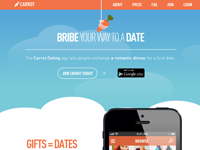
Dating App Carrot lets you Bribe your way to a Date

Reviews
  • Sunday, December 08 2013 @ 10:02 am
  • Contributed by:
  • Views: 1,699

Would you consider bribing someone to go out with you, say with a nice dinner or skydiving trip? According to Brandon Wade, an MIT graduate and founder of a new matchmaking app called Carrot Dating, most men would.

The idea behind the app (and its name) is that users can "dangle a carrot" in exchange for getting women to go out with them. (In fairness, the site claims that both men and women can accept or offer gifts in exchange for a date.)

Users can accept gifts or activities for a first date, from something as expensive as plastic surgery or as minimal as a tank of gas.

Most of the reviews for the new service have been skeptical, if not downright hostile regarding the purpose of the app.

Business Insider's Christina Sterbenz wrote in a scathing review, "through Carrot Dating, users (but really men)... can buy credits to send "gifts" to other users ... so they'll agree to a first date. That sounds quite like an activity illegal in most of the continental US - prostitution." She goes on to say that, "in fact, this problematic app is teaching men that women are greedy idiots who can't see through blatant and pathetic misogyny."

Wade has a different opinion however, especially when it comes to online dating. He maintains that women constantly get messaged while men struggle to get even one response. This is a way to level the playing field, to ensure that men get what they desire, too, instead of just messaging and hoping.

"Online dating is a superficial game," the Carrot Dating site claims. "With Carrot Dating, you won't get rejected before you even get a chance. Convince singles that spending time with you is worth it by making an offer that they simply cannot refuse."

But does this approach work in the real world, especially if you're looking for a real relationship and not just a pretty date?

Not likely. Some experts have chimed in too, noting that when you're buying presents in order to secure a first date, then she probably won't continue to date you unless you keep buying her gifts. There is no motivation to really get to know each other as you would on a traditional date without such bribes.

This app plays into the insecurities of men, especially when it comes to online dating. Unfortunately, it's not an app that can ultimately help them obtain a relationship. That takes work, not gifts. And it probably takes a few more messages and a more open mind.

Think You Can Find Love Without An Algorithm? You Might Be Wrong.

Matching
  • Saturday, December 07 2013 @ 01:23 pm
  • Contributed by:
  • Views: 1,436

When Aaron Schildkrout cofounded HowAboutWe.com, he had a vision for online dating, one that didn't rely on complex mathematical calculations to determine whether two people are compatible. He pictured a site where real-life dates were the focus, so users got straight to what really matters: meeting face-to-face.

"We branded ourselves as the offline dating site, as explicitly an alternative to these profile-heavy matching algorithm dating sites," he told The Washington Post. "It's about getting offline, going to the real world and getting chemistry."

It appears to be a smart approach at first glance, but since its founding in 2009, HowAboutWe has evolved to depend more on formulas, not less. As more and more users joined the site, the challenge was no longer to show them as many potential dates as possible, but to show them the right dates. In order to create an experience worth coming back for, HowAboutWe needed to get smarter.

HowAboutWe's two-person data science team created an algorithm that combines a user's profile information (like date ideas and demographics) with data gathered from that person's behavior on the site (e.g. what kind of profiles they looked at and how often).

In contrast to HowAboutWe's focus on casual dating, eHarmony believes its users are looking for long term relationships and its algorithm reflects that. eHarmony members are required to fill out a personality questionnaire with hundreds of parts developed from research of around 50,000 happily married couples. To determine compatibility, historical data is paired with analysis of users' behavior on the site and the constraints, like target age range, people place on their matches.

As expected, predicting love is no easy feat. Match.com president Amarnath Thombre says that what users claim they're looking for is often not the kind of profiles they actually view. How did Match cope with the mixed signals? "We said, 'We're going to base these things way more on actions you take. . . . If you start breaking your rules, we're going to start ignoring your rules,' " Thombre explained.

On AshleyMadison.com, the popular matchmaking site for affair-seekers, matching is driven almost entirely by an algorithm. "At least when it comes to the topic of infidelity, traditional research avenues have been kind of absent," said founder Noel Biderman. "There aren't a lot of universities out there that can give you wholesale data on how unfaithful this population or society is or what triggers this."

Can a mathematical formula ever fully replace the magic of serendipity? It seems unlikely, but if the two can work together, we stand a better chance of finding love than ever before.

For more about Aaron Schildkrout dating site you can read our review on How About We.

Gratitude and Your Love Life

Holidays
  • Friday, December 06 2013 @ 06:59 am
  • Contributed by:
  • Views: 1,665

Around the holidays, it's easy to get caught up in the bustle - shopping for gifts for friends and family, going to holiday parties, and keeping an active social life. But sometimes it can feel like a bit much - which is why a lot of people tend to get depressed over the holidays.

For some, the holidays are a reminder of everything you don't have in your life - whether it's money, a house you love, a good career, family close by, or a romantic partner. There is evidence of happiness all around you - in the decorations or non-stop Christmas music, and yet you don't feel inspired or happy. You see couples holding hands and families laughing together and you might wonder why you're still alone.

While you can't help your feelings, it's also important to remind yourself to be grateful for all the things you already have in your life. That's really what the holidays are about. And gratitude, more than anything else, will help you attract more happiness and love to your life.

While this might sound like a cliché, reminding yourself really works. Make a list! Here are some questions to help you get there:

What have you accomplished? For the entire year of 2013, write down all of the things you've accomplished that you're grateful for, no matter how small. Did you finish that half marathon? Did you start saving for a trip to Belize? Did you learn a little bit of French? Did you clean out your garage? These victories are all important reminders of what you are capable of, and the future you are working towards.

Who do you love? When you're sad about your love life and feel like you'll never find the right person, it's good to remind yourself about who is most important to you right now. Maybe it's your best friend, who always lets you cry on her shoulder, or maybe it's your Aunt Susan who has a plate of warm cookies for you whenever you visit. Remember the people who are there for you and send a little thank you note to each of them this holiday season. That means more than any purchase.

What do you love to do? Is there something you are passionate about, whether it's writing poetry, playing guitar, or surfing? The holiday season is a great time to indulge in those activities you most enjoy, and remind yourself that no matter what, you have passions in your life that can bring you joy. That's something to be grateful for.

Volunteer. If you're really stuck, volunteering to help those less fortunate than you is always a good reminder of how much you have in your life. Whether you go to a soup kitchen or help the single mother who lives down the street by offering to babysit her children, you're sending love into the world. And that is a good thing, no matter what time of year it is.

eHarmony Launches New Personalized Service, eH+

eHarmony
  • Thursday, December 05 2013 @ 07:02 am
  • Contributed by:
  • Views: 8,965

Good news, eHarmony users! eHarmony.com has just announced the launch of a new service designed to enhance the experience for those who want a higher level of service from their online dating site. The new service, called eH+, offers the best of eHarmony alongside a very special upgrade: a personal counselor.

The counselors are credentialed therapists working with eHarmony founder, himself a psychologist, Dr. Neil Warren. "Finding the love of your life is the single most underestimated challenge in the human experience," said Dr. Warren in a press release. "In the course of the dating process, we know that some people want or need a higher level of service in finding their marriage partner and since this decision impacts your life more than any other single decision, we want to provide help every step of the way."

So what exactly does it do?

"eH+ melds the power of eHarmony's online capabilities with the guidance and care of the matchmaking industry," said Grant Langston, Vice President of Customer Experience for eHarmony. "eH+ is exactly suited to take our proven compatibility algorithms and bring personal, one-on-one attention to the difficult process of finding the right person to share your life. We know that we have more marriages, with more satisfaction and fewer breakups than any other service and we are confident that eH+ will add another layer of strength to our already powerful process."

And that's not all. eH+ also promises:

  • Matches chosen for you by your credentialed professional counselor
  • Freedom from your computer - no updating profiles, managing matches, or juggling communication
  • Matches who have been vetted for interest in you, so you no longer have to wonder whether your interest is reciprocated
  • A deeper and more varied set of matches than what you likely would have encountered without an eH+ counselor
  • Increased privacy, because your profile isn't automatically exposed to hundreds of people you've never met

If you think all that personalization comes without a price, think again. The bespoke eH+ service will cost $5,000 for a one year subscription. It certainly isn't cheap, but according to eHarmony 66% of its members were surveyed and indicated they would be interested in subscribing (though who knows what "would be interested" actually means?). Unfortunately the service is too new to hear reviews from users.

eH+ launched in beta on November 1, and its official launch is set for December 1. For more information on this dating site and its features you can read our full eHarmony Review.

Amy Webb Tells TED How She Hacked Online Dating (Part II)

Matching
  • Wednesday, December 04 2013 @ 06:03 pm
  • Contributed by:
  • Views: 1,770

What do you do when you love data, but can't seem to crack the online dating code? Rewrite the code, of course.

That's exactly what Amy Webb, author of Data, A Love Story: How I Gamed Online Dating to Meet My Match, did. After a bad breakup, and a series of bad dates through online dating sites, Webb decided to turn her passion for numbers and algorithms into a strategy for hacking the online dating system. "Rather than waiting for an algorithm to set me up," she told a rapt TED conference audience, "I'm going to try reverse-engineering this entire system."

She began by writing down every possible trait she was looking for in a mate. By the end she had amassed 72 different data points that covered everything from religion, to occupation, to hobbies, to children and parenting styles, to travel plans, to body type. She then prioritized the list, breaking it into a top tier and a second-tier of points and ranking them from 100 down to 91. Finally, she devised a scoring system to mathematically calculate whether or not she thought the date would be a good match for her.

At first glance, her points system appeared to be a success. She returned to online dating and found a good-looking, well spoken, and well-traveled man she thought could be the man of her dreams. There was just one problem: he didn't like her back. That's when Webb realized there was one variable, the competition, she hadn't considered. What about all the other women on online dating sites?

Webb's next step was market research. She created 10 fake male profiles in order to gather data about the women who were attracted to the kind of man she really wanted to marry. She looked at both qualitative data (the humor, the tone, the voice, the communication style) and quantitative data (average length of their profiles, how much time passed between messages). Her findings are fascinating.

"Content matters a lot," she explains. "Smart people tends to write a lot, 3000... 4000... 5000 words, about themselves." Successful online daters also tend to use nonspecific language and optimistic language, which makes their profiles feel more approachable. Timing is also very important, Webb found. "The popular women on these online sites spend an average of 23 hours in between each communication," she says. "And that's what we would normally do in the usual process of courtship."

Armed with new insight, Webb could optimize her online dating approach and create a super profile. And it worked. She is now married and has a daughter, and wrote a book to share her insider knowledge of the online dating system with the world. The question is...what does all this mean for you?

"There is an algorithm for love, it's just not the ones that we are presented with online," Webb says. "In fact, it's something that you write yourself...all you have to really do is figure out your own framework and play by your own rules."

Related Article: Amy Webb Tells TED How She Hacked Online Dating

Page navigation