Location

Dating in America Today, According to Match.com and Zoosk

United States
  • Sunday, March 08 2015 @ 08:48 am
  • Contributed by:
  • Views: 3,047

Now that Valentine’s Day is behind us, many will forget the flowers and pink hearts lining the stores. But they won’t stop dating.

In fact, there are more studies than ever about the state of dating today – starting with Match.com’s annual survey of singles across America. Match found that daters were pretty optimistic, especially guys. More men than women believe in love at first sight, (and more women than men are afraid of commitment). 

Match.com also reveal women prefer their independence, much more than men do. Ninety percent of women want more personal space, 93% want to pursue their own hobbies and interests, and 64% want more time with friends. Most women prefer to wait 1-2 years before moving in, whereas men prefer to move faster – 6-12 months of dating before shacking up.

Also, there is something Dr. Fisher calls “The Clooney Effect” taking place. That is, men are going for intelligent, powerful women. 87% of single men would date a woman who makes ‘considerably more’ money and who is considerably better-educated and more intellectual than themselves; 86% seek a woman who is confident and self-assured, and 39% would also make a long-term commitment to a woman who is 10 or more years older.

So what’s holding you back ladies? It seems like you are in the driver’s seat when it comes to establishing a new relationship. “Technology is dramatically changing how we court, but it can’t change the brain systems for romance and attachment. And today’s singles are setting a high bar for courtship and marriage,” said Dr. Helen Fisher, anthropologist and lead researcher for Match.com’s study.

Zoosk has also come out with a study about the habits and preferences of online daters, so we can get a better picture of what singles are looking for. According to its figures, women like outdoor types – guys who posted pictures hiking, biking and other outdoor activities received 19% more messages than those who didn’t.

Also, selfies aren’t a great thing to use, unless you are expert with the camera. Women who took selfies received 4% more messages, while guys who posted selfies took a hit – they received 8% fewer messages. But the women who took full-body selfies? They received a whopping 203% more messages.

In both studies, men and women both preferred people who had a grasp of good grammar and spelling. If you chose to answer messages with “cuz” “im” or “u” – on average, you received 13% fewer messages on Zoosk. Match.com revealed this was the number one turn-off for daters (even over text), with 54% of women and 36% of men agreeing.

So if you’re looking for love in 2015, put a little time and effort into your search, and keep a positive outlook – you are in good company!


Coffee Meets Bagel Secures $7.8 Million in Funding

United States
  • Friday, February 27 2015 @ 06:29 am
  • Contributed by:
  • Views: 2,011

Coffee Meets Bagel has been overshadowed by its more aggressive competitors (like Tinder), but lately has emerged as a serious, lasting contender in the dating app space. The company is showing its app has real growth potential by securing $7.8 million in a Series A financing round led by existing investor DCM Ventures. Quest Ventures and Azure Capital also participated in the round.

This round of financing is followed by the steadily growing success of an app whose founders like to take things slowly, testing what works in each market (starting with its launch in 2012 to New York and Boston markets) before moving on to the next. Recently, the company expanded from an iPhone-only app to include an Android app as well, opening markets further.

Coffee Meets Bagel sets itself apart by making the dating app experience feel more personal. People are connected through their social networks – through mutual friends on Facebook, for instance – so there is a level of assurance that you can avoid the scammers and fake profiles. Also, CMB users receive only one match per day, avoiding the whole Tinder hook-up potential. Each day, users have 24 hours to message their match, and then a week to set up a date before they vanish into the ethers. The point is to keep the conversation going, instead of just letting messages and matches accumulate while users see who else is out there.

While the design is game-like (you can get “coffee beans” by providing information or referring friends to the service, which in turn can be used to access additional features, like the ability to see who your mutual friends are, or to rekindle the flame with a match you neglected to message in time.) The company also teamed up in certain cities with local businesses to offer discounts to places you could go for a first date, although the growth of the app nation-wide has prevented them from doing this in more than a few major cities.

The additional funding will pay for engineers and developers to help build the core business so it can handle the projected growth in users. While the company hasn’t publicly shared their subscriber figures lately, the interest from investors is telling.

CMB has been compared to dating app Hinge and Are You Interested, which also focus on matches based on mutual social media connections.

The additional financing follows the company’s earlier participation in the TV series “Shark Tank,” where the founders proposed their business plans to celebrity investors in the hopes of gaining additional funding. While they didn’t get it from the TV show’s panel of judges, they have been successful in raising the funds elsewhere.

High There – A New Dating App for Weed Lovers

United States
  • Friday, February 20 2015 @ 06:32 am
  • Contributed by:
  • Views: 2,891
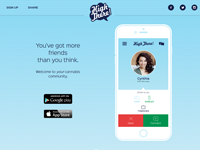
High There Dating App

It was only a matter of time before a Denver-based app developer would take advantage of the city’s new legalized pot industry. High There! - a new dating app specifically for weed lovers, launched this month for Android and will be debuting in the iTunes store soon. In addition to the mile-high city, the app is also available in 23 states that have legalized medical marijuana laws.

High There has been described as “the Tinder of pot smoking,” although instead of matching according to proximity and age preferences, the app asks for your weed preferences, such as vaping or smoking, and what your energy level is when you are imbibing – “low energy couch potato or high energy explorer,” according to a report on Mashable.

The design of the app is similar to Tinder, with photos as the main feature and the ability to accept or reject a match by swiping left or right. Besides how you consume your pot, a few extra questions are added to enhance your profile, including what you are in the mood for – “go out, stay in, or chat?” and your interests (“culture, outdoors”).

CEO Todd Mitchem says he was inspired to create the app after his date called it quits when she found out he smoked pot. It wasn’t the first time it had happened, so he decided he’d rather only date pot smokers – but needed a way to meet them. He wanted to build a community around people who might otherwise feel shunned for their habit. He told Mashable that the app “can also act as a kind of social network for smokers who are seeking recommendations on local dispensaries, to share tips or just make friends with other like-minded folks.”   

High There however is not the first dating app to cater to this particular clientele. My420mate launched last year, and 420Singles has been offering their pot-friendly app for a while as well, though High There seems to be getting a lot more attention in the press.

So far, the reception to High There has been mixed, according to reviews in the app store. The main reason for users’ frustration is that they download the free app and then can’t use it because of the marijuana laws in their particular cities. (If it isn’t available to purchase legally in your town, you can’t use the app.) Many people complain that they do have medical marijuana cards from another city, but can’t use the app because of the legal status in the city where they live.

High There is free and available for Android users, and will soon be available for download from the iTunes store.

Dating Services in Canada Statistics

Canada
  • Thursday, February 19 2015 @ 11:34 am
  • Contributed by:
  • Views: 2,918
A new "Dating Services in Canada Market Research Report" has been released in January 2015 by IBSWorld. The report requires payment to read the entire thing (no less than $725 US) but they did release a few interesting statistics for promotion that are worth mentioning.

According to IBSWorld the dating industry in Canada grew 6% from 2010 to 2015. They feel this rate is low due to the recent recession but the rate of growth is expected to increase in the next 5 years.

In Canada there are 255 businesses in the dating industry that employee 523 people. On average this means every dating business employees 2 people. In my experience the case more likely is that most of the businesses employee 1 person (the owner), a few probably employ 2 to 5 employees, and the very few employ 5 or more. The reason for such a low number of employees and high number of businesses is the relative ease and extreme low cost required to get into the dating industry. Free dating site software can be found online and web hosting can be found as cheap as $5 a month.

The report also mentions that revenue generated by the dating industry for the year in Canada is $153 million. This seems rather good especially with 255 businesses which would suggest that on average each generated $600,000 in revenue. This is not the case either. Most of these dating businesses probably either make virtually no money or only generate a few thousand a year in ad revenue. A few probably generate 10's of thousands, and even less generate hundreds of thousands or even a few million. I believe the majority of this revenue is made up of one dating site, Plenty of Fish. POF is located in the province of British Columbia, Canada. All of the other popular dating services are based in the United States. POF is a private company and no revenue numbers have ever been officially released. That being said they are one of the most successful dating sites in the world so I am sure their revenue for a year is probably 10's of millions of dollars. For comparison just take a look at the Match.com dating site. They are a public company owned by IAC and they reported the Match Group earned in the fourth quarter of 2014, $241.5 million US. That is only for 3 months so in a year they generate around 1 billion dollars. Now the Match Group is made up mostly of paid dating sites while POF is a free service which generates revenue from ads as well as paid upgraded memberships. I don’t expect POF to earn hundreds of millions every year but as I said, with their traffic I do see them earning 10’s of millions.

Is this latest IBSWorld report worth getting? It definitely would be an interesting read but the thing with the dating industry is that it is global. If you are opening a dating service you usually don’t just target one country. You would target continents as a whole like North America or Europe. If you are considering purchasing the document I would probably hold off and wait for the US version to come. The US is 10 times the size in population of Canada which is a much bigger customer base.

Users Unhappy With Tinder Changes, Sparks Outrage in App store

United Kingdom
  • Friday, February 13 2015 @ 09:37 am
  • Contributed by:
  • Views: 1,649
This month, Tinder began rolling out its new premium service Tinder Plus in select European markets, and the feedback hasn’t been good.

The popular dating app surged to the top of the online dating market when it launched in 2012, attracting users who had never thought of signing up for an online dating site. Its easy-to-use format and free game-like service offered more entertainment than dating stress, and users flocked to check it out.

But in an effort to make money from this hugely successful endeavor, it was only a matter of time before Tinder’s owners developed a paid model for the app – opting for a premium service over adding distracting in-app advertisements. (Although the company has strategically lent its brand to marketing campaigns, like Gillette’s facial hair survey and Domino’s Pizza Valentine’s Day campaign.)

But Tinder Plus has not been greeted favorably, at least in its initial roll out – and the free service is suffering as a result. Although Tinder Plus is not set to launch in the U.S. until March, and prices are still to be determined, the company needs to find a new strategy - considering the backlash it has gotten in markets where the roll out has already taken place, such as the U.K. Tinder users who are not opting to pay for Tinder Plus and want to stick to the old free version of the app have been leaving bad reviews in the iTunes store (enough to drive the free service’s rating down to one and a half stars).

The problem has to do with new restrictions to the free service. Once a user has swiped a certain number of times, they are blocked for 24 hours from seeing any new profiles, unless they want to pay for the new Tinder Plus service. Since most users log in to Tinder multiple times a day to swipe through matches, this puts a serious hindrance on Tinder’s competitive advantage. Other dating apps that have restrictions on the number of profiles a user can see per day – like Hinge - have been easing up on their requirements, and seeing a surge of new downloads as a result.

With all the promising new free apps coming on the market, such as Bumble (started by an ex-Tinder employee), Tinder will need to think outside the box to keep its market share. After all, any online dating app or site’s currency is their user base. If Tinder loses theirs, then they stand to lose a lot more than the revenue from the premium service. Perhaps they should stick to advertising deals, or instead of taking away features from loyal users, offer more enticing new features.

New “elitist” dating app The League launches in San Francisco

United States
  • Tuesday, February 03 2015 @ 06:26 am
  • Contributed by:
  • Views: 2,248
The League

The latest dating app launch is capturing a lot of buzz - and aimed at marketing to the so-called “dating elite.” If you’re single and successful, The League might be the app for you.

The League has gotten attention because of its latest round of funding. Though founder Amanda Bradford was at first looking to raise half a million according to Time Magazine, she has now received $2.1 million from investors looking for the next Tinder – but without, you know – all the low-brow hook-ups.

The League differentiates itself from its competition by offering exclusivity – you have to be accepted into its network. The acceptance algorithm it uses according to Business Insider “scans the social networks to ensure applicants are in the right age group and that they are career-oriented.” The article goes on to say: “That doesn’t mean they have to be Ivy graduates or work for a big-name firm. But they should have accomplished something in their 20s.”

If you are accepted, you are given a limited number of matches each day at 5:00pm, which The League calls “Happy Hour.” You are also given the ability to refer one friend.

The League isn’t the first app to offer more “quality” matches as opposed to the giant dating pool that is Tinder. Hinge is invitation-only, working from your social media circles and offering a limited number of matches per day, as does Coffee Meets Bagel. The difference is that The League utilizes LinkedIn to find matches, avoiding direct contacts (like your boss) and working with those a little further removed. Some have argued that this blurs the line between business and personal, although eHarmony announced earlier this year they would be offering job-matching services to employers and potential employees.

So far, The League has attracted around 4,500 users from San Francisco. Like Hinge, CEO Branford wants to move slowly, city by city, to build her network in a more thoughtful way. She discovered most couples meet through school or work connections, and she wanted to optimize these already-existing networks (hence using LinkedIn for matching). In fact, she is doing much of the business networking herself by attending parties of tech execs in Silicon Valley and fundraisers in San Francisco. She walks around demonstrating her app and offering bracelets with the app’s logo to attendees.

“It isn’t an app for everybody,” Branford told the New York Times. “We’re trying to hit home that…people do have high standards.”

Page navigation