Communication

Dating app Hinge Bets on its Ability to Compete with Tinder

Communication
  • Monday, November 03 2014 @ 06:45 am
  • Contributed by:
  • Views: 1,728

At the end of 2012, dating site Hinge had recently launched and was overshadowed by the popularity of dating app Tinder. Unsure of how to proceed with less than $32,000 in the bank and only a few thousand users according to Business Insider, Hinge decided to bet big on the mobile platform.

"We made some business assumptions that turned out to be wrong," Hinge CEO and founder Justin McLeod told the news website. "We were like, 'This thing is running out of money, and we need to do something drastic."

In what seems to be a spur-of-the-moment business decision, McLeod and a couple of developers holed up for a few weeks and launched a mobile version of Hinge on February 7th of 2013. But the launch wasn't as smooth as expected - Apple at first rejected the app, which caused many sleepless night for McLeod and his company. They had planned a huge launch party in Washington DC where the app first launched, and until the morning of the launch party, there was no app available.

The launch party turned out to be a success, and more people signed up right after it than had signed up for the beta in all of 2012. It seemed Hinge struck a chord with users where Tinder left them feeling insecure - especially women. Hinge does not just match users based on location like Tinder does (which means a lot of random profiles get into the mix) - you only get matched through your circle of Facebook friends of friends, so everyone you meet on Hinge has some kind of link to your circle. This security has been particularly attractive to female dating app consumers.

McLeod is not about to sit still. He is grabbing a good portion of the dating app market share, and expects to compete heavily with Tinder for its core user base. But he's taking things one step at a time.

Instead of launching his app nationally, he has launched city by city, building up a solid user base based on demand before he moves into a new market. Also, potential Hinge users must be invited by current Hinge users - adding a level of exclusivity and security to the app.

Hinge is now one of New York's hottest startups. Although Tinder is much larger (it makes more matches per day than Hinge has in its entire history), McLeod's company is starting to steal some Tinder users. It has expanded to 20 cities including Los Angeles, San Francisco and Washington, D.C. It uses a waitlist to assess demand in other cities, then launches when a few thousand people have signed up.

"There is no shortage of companies that have tried to build what we've built," McLeod says to Business Insider. "But we're using the organic, city-by-city method, which I think is the biggest thing ... We're a utility to help users meet great people in the flesh as effectively as possible ...We want to be a house party that has a really good host."
Are Paid Online Dating Sites in Decline?

Communication
  • Sunday, November 02 2014 @ 08:27 am
  • Contributed by:
  • Views: 2,556

Online dating sites like OkCupid and Plenty of Fish have had a free model for a long time, which has managed to expand their membership databases and make them tough contenders with paid sites such as Match.com and eHarmony. But now that free dating apps like Tinder have entered the picture and taken the dating world by storm, the paid dating sites have seen not only a decline in membership, but also in revenues.

Is online dating on its way out?

According to a recent article in The Economist, paid online dating sites have reason to worry. In the article, The Economist points out Cupid, who runs subscription-based dating websites such as Cupid.com, UniformDating.com, and LoveBeginsAt.com, announced a $4.9 million loss in the first 6 months of 2014, up 20% from last year. The number of members has dropped, too. At the end of 2012, Cupid’s sites had 113,000 paying members, but by June 2014, they had just 48,000.

While this is a disturbing trend for online dating sites like Cupid – which haven’t really taken off like other paid sites Match.com and eHarmony – it could weed out many contenders in the online dating market over the next couple of years. However in contrast to Cupid's earnings, eHarmony recently reported incredible subscriber growth and better earnings than they have seen in years, due to focusing on long-term relationships and technology that they market as extremely valuable for finding the “right” match.

But what about popular free dating apps and websites like Tinder and old-timer OkCupid? They have attracted users because of their easy set-up and accessibility. They have made online dating less intimidating, (although a little more sketchy according to some users). Are they responsible for the decline in companies like Cupid? 

Not necessarily. Even free apps and websites aren’t so free anymore.

There has been a shift for the free dating apps and online sites to offer “freemium” services – that is, additional features to the basic service but for a price. In the current online dating market, revenue growth needs to happen for investors to remain interested, and that means charging for services once the user base is built. Tinder recently announced that it will launch a premium paid service in early November, while the basic features of the app will still be free. OkCupid started with a freemium model a while ago, charging users who want to filter profiles according to user preferences, or to be able to review and see reviews of other members.

Still others like eHarmony are adding more personalized matchmaking services at a very high price – thousands per year – for those who want a relationship but would like someone else to do the heavy lifting. eHarmony has not reported numbers to see the success of this particular service.

So what does the future look like for online dating? One thing is for sure: free models likely won’t last forever.

Match Launches A Brand New iPad App

Communication
  • Wednesday, October 29 2014 @ 07:15 am
  • Contributed by:
  • Views: 1,756

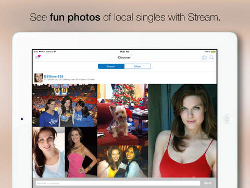
I've got good news for Apple fans. If using the Match app on your iPhone and iPod Touch just isn't enough for you, you can now get your fix on your iPad, too. Match has just announced a brand new, redesigned, fully maximized app for the the larger iDevice with iPad-optimized functionality.

Check out the new app in the App Store or at Match.com and get the scoop on its robust features below:

See Endless Photos With Stream

Stream is an iOS-exclusive feature that uses an innovative algorithm to serve up photos of singles. Stream finds the members closest to you and highlights photos in their profile in addition to the primary profile pic. Because the iPad has a larger screen, Stream can display multiple pictures at once. Ostensibly it's there to help you discover more of someone's personality, but let's be real: you're not looking for personality in the pics.

Make Quick Connections with Mixer

We live in an era of NOW, so Mixer aims to match you with potential partners at warp speed. Using geographic location, another exclusive algorithm, and your favorite swiping technology, Mixer makes it easier than ever to browse profiles.

Additional Features

Stream and Mixer are the big additions to the new Match App for iPad, but it's got plenty of other interesting ingredients to look forward to:

  • Facebook sign-in: Signing into your Match.com account just got even easier. Now you can sign in using your Facebook credentials.
  • Grid search: The impact of Pinterest is undeniable. Now you can see more singles at a time with Match's enhanced search view, which takes a cue from Pinterest's famous grid.
  • Easier photo uploading: The snap-happy can now add photos from three different locations within the app's interface.
  • In-app notifications: Stay even more connected in this hyper-connected world with in-app notifications.
  • In-app purchasing: For the first time, you'll be able to purchase subscriptions and additional features while you're signed into your iPad app. How did it take Match so long to make it even easier to spend money on their products? Who knows, but you'll be glad you can when you're itching for an upgrade on-the-go.
  • More ways to communicate: Your communication options are practically endless in the new Match iPad app. You can chat with potential dates throughout the entire app, from Stream, to your Daily Matches, and even directly from a member's photo. And there's no waiting – you can communicate from the second you start up the app.

Why You Should Stop Putting So Much Effort Into Your Online Dating Messages

Communication
  • Thursday, October 23 2014 @ 06:43 am
  • Contributed by:
  • Views: 3,902

Yep, you read that headline right. And the news comes straight from the mouth of Christian Rudder, co-founder of OkCupid and writer of the OkTrends blog, so you know it's worth paying attention to.

Messages are usually the most private part of an online dating site, but Rudder gets special access and he's used it for another interesting wave of online dating research.

First, he took a look at the history of technology and how it altered the way we communicate. The notable moment came in 2008, when Apple launched the app store and everything went mobile. The effect on OkCupid users' writing was practically instantaneous. Smartphone-using singles started typing on teeny-tiny keyboards, and as a result message length has dropped by over two-thirds in the 6 years since.

These days, the average message is just over 100 characters. It seems like nothing, but users have adapted. Messages that get the highest response rate are now only 40-60 characters long.

Then Rudder examined how much putting time and effort into messages leads to better results. He looked at messages between 150 and 300 characters and plotted them against the time it took to write them. The outcome? Taking time to craft your messages helps, but only to a point. A peak is reached at around the 120-second mark, and after that you're just overthinking it.

There are also those out there who maximize their time by – sigh – cutting and pasting. And there are a lot of them. All told, 20% of the sample registered 5 or fewer keystrokes per message. “Sitewide,” writes Rudder, “the copy-and-paste strategy underperforms from-scratch messaging by about 25 percent, but in terms of effort-in to results-out it always wins: measuring by replies received per unit effort, it’s many times more efficient to just send everyone roughly the same thing than to compose a new message each time.”

So there you have it. Like it or not, cut/paste is here to stay. It may be a little less effective, but it's far more efficient. Those who choose the CRTL + V strategy are actually just harnessing technology and hacking the online dating process – and doing so is probably making them far more successful than you, person who spends an hour personalizing every message.

RIP faith in humanity, hello more time to spend watching cat videos on YouTube.

4 Scary-Bad Pieces Of Online Dating Advice You Shouldn't Follow

Communication
  • Wednesday, October 22 2014 @ 07:00 am
  • Contributed by:
  • Views: 1,242

Normally the type of scares we talk about come October are the ones that involve zombies and werewolves and candy-craving kids hopped up on too much sugar, but around here we're more concerned with a different kind of fright.

Over the last 8 years, I've spent a lot of time reading, writing, and occasionally even following online dating advice. And whew...there is some scary, scary stuff out there. Plenty of people get it right, but let's be honest – plenty more get it wrong, so wrong it's almost scary how bad it is.

I spend most of my time on the good advice, but Halloween puts me in the mood for being horrified so today we're taking a detour to Terrortown. All of the advice you're about to read? Don't follow it, unless you want to be an urban legend singles tell to scare each other off online dating.

Do iPhone Users Have More Sex?

Communication
  • Monday, October 20 2014 @ 07:23 am
  • Contributed by:
  • Views: 1,482
page

A new study by German researchers shows that men who are looking for more casual sex are more willing to spend money for the new iPhone 6 rather than purchase a cheaper Android phone.

According to website Science of Relationships, Christine Hennighausen and Frank Schwab of the University of Wuerzburg asked 350 men and women how likely they would be to buy an Apple iPhone or a Samsung Galaxy Ace. (The Samsung device sells for about 20% of the price of an iPhone.)

The experiment showed that men’s desire to purchase an iPhone depended not only on whether he was in a committed relationship, but whether he was looking for a long-term relationship or just casual one-night stands. As it turns out, men in committed relationships were no more or less likely to purchase an iPhone as compared to an Android. But single men who were looking for long-term relationships were less likely to buy that iPhone compared to single guys who were looking to score.

This phenomenon isn’t new. A few years ago, OkCupid did a study and found that daters with iPhones had almost twice as much sex as Android users. This was broken down further by gender and age, but the research was there – iPhones are definitely a sexual turn-on.

The researchers in the German study asked the participants about their sexual behavior, with questions such as “How many different sexual partners have you had in the past year?” and “With how many different partners have you had sex on one and only one occasion?” Higher numbers indicate a tendency toward flings, or a casual dating strategy.

When the researchers disregarded the men’s mating strategy, they found that uncommitted men were more willing to purchase the cheaper Samsung phone. So just because a man is single you shouldn’t assume he’s just looking to score. Apparently, his willingness to buy that iPhone depends on whether he is marriage material or prefers promiscuity. So the fact that more men seem to be buying Android phones is a good sign for ladies who are looking for long-term relationships.

The researchers found that more women in the study chose to purchase Android phones rather than iPhones, though their decisions weren’t influenced by their dating strategies as were the men’s.

Another interesting finding: single men who did purchase those iPhones tend to have them on display when there are women around them. This is not surprising in light of the findings – and the fact that those men put down a few hundred dollars to be first in line to get their shiny new devices, so they might as well show them off and see what happens.

Page navigation