Matching

Japanese Singles are Weary of Online Dating

Matching
  • Wednesday, August 19 2015 @ 07:40 am
  • Contributed by:
  • Views: 2,807

In Aziz Ansari and Eric Klinenberg’s new book Modern Romance, they discuss the disconnect of online dating in Japanese culture. Despite Japan’s adoption of and love for technology, single people still stigmatize online dating.

The reasons are part cultural and part historical. Japanese singles haven’t had a good experience with online dating, historically speaking. In the 1990’s when online dating first hit the singles scene, online dating companies had male members pay per message and also used their female employees as bait, posting their profiles on the dating sites to attract more male users. More recently, fake dating sites have been exposed, with companies using male employees to pose as girls on the sites and charging their male members to talk to them – (obviously, those members never get to the date).

It’s easy to see why Japanese singles are skeptical. But now dating apps have made things a little easier to verify. First, like most dating apps all over the world, users are verified through their Facebook profile, so it’s not easy to create fake accounts. And Japan is really embracing social media, especially after both LinkedIn and Facebook helped families find each other after the 2011 earthquake.

But another interesting trend is happening with Japanese online daters. The culture is rather conservative when it comes to dating – and guys don’t want to be thought of as players. Since dating apps have become synonymous with hook-ups, Japanese - and men especially - are weary to sign up for fearing like they will come across as insincere. So people aren’t really embracing online dating.

In fact, they aren’t dating much at all. Most Japanese singles are much more focused on work, which means working long hours and delaying starting a family. This is also taking a toll on their social lives. A 2014 survey by the Japan Family Planning Association found that 49% of all respondents had not had sex in the past month, and 18% of men said they had no interest in sex at all. On top of this, they face a serious population decline.  According to Business Insider, a 2012 report by Japan's National Institute of Population and Social Security Research shows the number of Japanese people will fall from 127 million to around 87 million by 2060.

Still not everyone is averse to online dating. The country has seen some interesting trends.

Selfies tend to be popular with online dating in most countries, but are looked upon as narcissistic in Japan. Even a photo showing an online dater by herself is frowned upon because Japanese tend to view this as self-centered. Most daters either post photos with a group of friends (so you can’t really identify the person you are meeting), or they post photos of their cats or random objects. One of the weirdest trends among online daters is posting photos of their rice cookers in their profiles, according to Modern Love.

There are definite cultural and practical barriers to get beyond when it comes to online dating in Japan. But as time goes on and it becomes more trust-worthy and mainstream, hopefully singles will embrace it.
 

Do You Want To Give Up Online Dating?

Matching
  • Saturday, August 08 2015 @ 07:32 am
  • Contributed by:
  • Views: 1,191

When I talk to daters, the majority of them have tried online dating and decided it just “doesn’t work” for them. I understand – we have all been through some bad and good online dates, and sometimes when you have a string of disappointments it’s enough to make you want to give it up altogether.

Here’s why you shouldn’t.

I’ve heard the arguments about how dating and meeting people should be more organic, that people on online dating sites are just looking to hook up, that it’s hard to know who you are really meeting when you get to the date because your dates don’t look like their photos. All of this happens from time to time. But it’s also important to remember one basic and compelling fact: online dating makes meeting people much easier than approaching strangers at the grocery store, for instance.

Online dating is really a misnomer: it should be called online meeting, as Dr. Helen Fisher of Match.com once pointed out. It is an avenue of introduction, but it is only that: an introduction. There’s no guarantee of love at first sight, that you will have the same goals, that you have a similar sense of humor, that there will be chemistry. But you will have people to choose from, who have chosen to take part on the site, and to date (as opposed to that random stranger at Starbucks who might already be in a relationship).

We have become products of the online dating generation, which makes actual dating more difficult. We expect to know as much as possible about someone up front before we agree to spend time together, even if it is just over coffee for twenty minutes. We approach dates with caution and skepticism. We shut down if there isn’t that instant spark of chemistry, instead of trying to get to know someone past the awkwardness of a first date.

Most importantly, we’ve come to expect that there is always someone “better” out there, waiting to meet us. Daters tend to prefer to keep swiping on Tinder even after they have met someone who sparks their interest, because maybe – just maybe – that next person will be even better. So we’re never in the moment – we just anticipate meeting the next person, and then the next. This is killing dating.

In order to feel chemistry, to connect with someone, you have to be present in the moment. You have to be fully engaged. Otherwise, the connection simmers, and perhaps you both walk away feeling “meh.” Then it’s on to the next – and that person might have really been a good match. You just didn’t give him/ her enough of a chance.

So on your next date, take your time. Engage. Try to be fully present. Put away your phone. Talk. Ask questions. Listen. Then see how online dating works for you.

Tinder Watch App uses Heart Rate to Approve Matches

Matching
  • Thursday, July 30 2015 @ 07:41 am
  • Contributed by:
  • Views: 1,545

It’s a revolutionary time in online dating. Now your physiology will be making decisions about who you should date, instead of having to rely on your own decision-making process to swipe left and right.

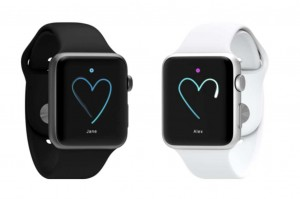
The new Tinder app debuting on Apple Watch called Hands-Free Tinder, created by developers from Austin-based integrated marketing and advertising firm T3, links a person’s heart rate to their interest in potential matches. Since pulse rates quicken when you are attracted to someone, the technology tracks this and suggests that you are a match. If there’s no quickening of heart rate? Then it’s an automatic rejection.

The process is entirely automated, meaning you don’t have to do the swiping yourself. The watch app does it for you. (Which kind of takes the fun out of Tinder, doesn’t it?) By simply looking at someone’s picture, the app will determine whether to reject or accept a match, all based on the user’s heart rate.

The Apple Watch won’t be the only wearable technology getting the new Tinder app – it will also become available soon on Google Play, so Android wearables will offer Hands Free Tinder, too.

“Swiping left and right is a thing of the past,” explained the developers to the UK’s Daily Mail. “After we found out that the Apple Watch could detect heart rate, we went to work developing hands-free Tinder. Now you can follow your heart to the right match.”

An article in Tech Times pointed out the precariousness of relying on heart rates to monitor attraction or interest in a potential date. Hands-free Tinder does not discriminate. If you are excited in that moment, whether it’s because you saw an old friend or took the first sip of a delicious drink, then your watch will right-swipe for you. The same thing goes if you are excited in a bad way, like if you witness an accident or suddenly remembered that you didn’t turn the stove off when you left the house. It will swipe right for you in these instances, too, because your heart rate goes up. So it’s important to not allow yourself to be distracted while you’re using the new app.

The smartphone helped propel online dating into the mainstream, making it easier than ever for people to choose or reject matches based mostly on a few photos. It has also encouraged our tendency toward laziness, especially when it comes to dating. Instead of manually accepting or rejecting matches, the next evolution of online dating says it will be done for us. Where’s the fun in that?

For more information on this dating app you can go ahead and read our review of Tinder.

Match CEO Sam Yagan Explains The Algorithms Of Love

Matching
  • Friday, July 03 2015 @ 08:39 am
  • Contributed by:
  • Views: 1,479

2015 is a momentous year for Match.com. The site debuted in 1995, making this its 20th birthday. In a world that's hit with a new app – the next big thing! – practically every other day, that kind of longevity is something to celebrate.

The world has changed drastically since Match first hit the scene. The intense stigma around online dating is all but gone. And though Match used to be the only one in its class, it's now one of thousands of dating services competing for attention.

In honor of two decades in the biz, Match CEO Sam Yagan sat down with Here & Now’s Lisa Mullins for View From The Top on NPR. He shared his insights on getting ahead and staying ahead in a competitive industry, and the impact Match has had on the world.

Yagan is a firm believer in the power of numbers. “When the choice was: Do I want my love life determined by a psychologist or a mathematician,” he says, “I pick mathematician every day of the week.” He happily puts his trust in online dating algorithms and data as a means of finding love.

However, he also admits that they have limitations. “I think it’s unrealistic to say that we can look through millions of people and find the one person who is best for you,” he adds, “but what we can do is of these millions of people, here are the top 100 that might be the best for you.” It's up to you to do the rest. A dating service may one day be able to predict chemistry well enough to identify “the one,” but Yagan speculates that it's still a long way off.

As CEO, Yagan goes to great lengths to keep Match on top. His first focus is the customer. He regularly asks friends, family, and other singles what's going on in their dating lives, so he knows what pain points his product can solve. He also keeps an eye on the competition. “I have all of our competitors’ apps on my phone,” he says.

So far, his strategies are working. Yagan isn't shy about discussing the influence of Match. “If you think about products that really impact humanity,” he says, “dating is one of the most influential out there.”

It's not just about helping people find love for Yagan. It's about breaking down barriers and expanding horizons. He adds, “The relationships that come out of online dating cross more boundaries than those that don’t, so I think in that way it’s very influential and it has a huge impact in the trajectory of our society.”

Big words and big promises, but with all Match has achieved so far, the next 20 years of dating are guaranteed to be interesting.

'How to Make Online Dating Work,' According To Aziz Ansari

Matching
  • Sunday, June 28 2015 @ 10:35 am
  • Contributed by:
  • Views: 2,172

Who is your go-to for dating advice? Your best friend? A parent? A stand-up comedian?

The last one may not be the first thing that comes to mind, but Aziz Ansari is out to change that. Together with Eric Klinenberg, a professor of sociology at New York University, he has penned a new book called Modern Romance. In a recent article for The New York Times, the duo shares a few insights gleaned from two years of research for the book.

“Online dating generates a spectrum of reactions,” they write, from exhilaration to fatigue to fury. The question is, “Is there a way to do it more effectively, with less stress?” After two years of study, Ansari and Klinenberg believe the answer is yes. They offer the following tips for singles looking to make online dating work better.

Don't rely too much on algorithms. You can filter to your heart's content, but at the end of the day, “we are horrible at knowing what we want.” Think of online dating as a vehicle for meeting people, rather than a method for finding the love of your life. An online dating site can only predict so much. Introductions are guaranteed, but only by meeting in person can you decide if you have long-term potential as a couple.

Your picture matters (probably too much). OkCupid launched an app called Crazy Blind Date that offered users only a blurred photo and minimal info. After going on the date, users were asked to rate their satisfaction with the experience. On OkCupid's regular site, women who were rated highly attractive were unlikey to respond to men who were rated less attractive. But when they were matched using Crazy Blind Date, they had a good time.

What does that mean? According to Christian Rudder, an OkCupid co-founder, “people appear to be heavily preselecting online for something that, once they sit down in person, doesn’t seem important to them.” Next time you look at a photo that doesn't seem quite up to snuff, remember that the person behind it could be exactly the date you're looking for.

Swipe apps don't deserve the stigma. You've heard critics complain that swipe apps like Tinder are too superficial, but Ansari and Klinenberg call that cynical. “When you walk into a bar or party,” they write, “often all you have to go by is faces, and that’s what you use to decide if you are going to gather the courage to talk to them. Isn’t a swipe app just a huge party full of faces?”

For more insight into modern romance, read the original article and, as Tim Gunn says, “Make it work.”

Find Love In Your Browser With 'Tab'

Matching
  • Tuesday, June 23 2015 @ 06:40 am
  • Contributed by:
  • Views: 1,268
Tab Dating

Online dating sites have long wrestled with replicating the experience of dating in real life.

Offline, the love of your life may find you at any moment. You could be standing in the produce section of the grocery store, wondering how to tell if a cantaloupe is ripe, when suddenly an attractive stranger appears to help you pick. It's all about serendipity.

Online, dating feels calculated. You'll never randomly bump into The One. But if U.K.-based Tab has anything to say about it, serendipitous meetings could soon be a part of your digital dating life.

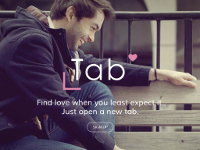
Tab isn't a dating website. It's not a trendy new mobile app. In fact, it's a browser extension for Chrome. Every time a user opens a new tab, they're shown a potential match. If they're not intrigued by what they see, they simply carry on with business as usual. If they do feel a spark, they click a heart button. Mutual “hearts” are connected.

"Imagine you could bump into the love of your life on any corner of the Internet, just like in real life," Shib Hussain, one of Tab's co-founders, told Fast Company. "It was a light bulb moment. We were discussing how online dating is actually pretty time consuming, regardless of what platform."

“You have to actively look for people, switching from ‘not looking’ to ‘I am looking.’ And this isn’t how it is in real life," he said. "You just bump into people and it just happens."

Tab works its magic based on the profile users fill out during sign-up. The fledgling company is also testing out a more intriguing concept: matching people based on the types of sites they visit. It sounds ripe for a debate about online privacy, but the idea is interesting nonetheless.

Productivity gurus may also find fault with the extension. Tab is aimed at users over 25 who are trying to find a healthy work-life balance, but it may be hard to focus on the work part if life interrupts every time you open a new tab.

Hussain says Tab is trying to combat that issue with a simple, clean aesthetic. The design is intended to give users information quickly, with minimal annoyance or distraction, so they can get back to their busy days (and all the other tabs they have open).

So far Tab has launched in beta in the UK, and hopes to go live in the US later this year. A mobile version could also be on its way in the future.

Page navigation