Studies

Study Reveals The Impact Of Netflix On Your Love Life

Studies
  • Monday, February 29 2016 @ 09:28 am
  • Contributed by:
  • Views: 2,348
Netflix Dating Study

As ubiquitous as the phrase “Netflix and chill” now is, it's not surprising that the streaming site could impact your love life. According to a new study released by Netflix itself, the shows and movies you watch online do affect your search for a soulmate.

The study, which examined a sample of 1,008 Americans 18-39 years old, found that around one third of respondents (27%) said show compatibility was important. Yes, in 2016, 'show compatibility' is a real thing. Netflix even coined the term 'show goggles' – the psychological phenomenon resulting in a drastic change in perceived attractiveness based on taste in TV shows.

A quarter of respondents admitted to having show goggles, with 13% saying they would ask someone out solely based on if they liked similar shows. Men seemed to be more susceptible than women – 34% said they are likely to get smitten based on shared tastes in shows and movies.

As we date, Netflix helps us get closer. Fifty-eight percent of study participants said they bond over Netflix. Instead of asking questions over coffee, discussing movie and televeision preferences helps us get to know each other better. Sixty-five percent said they engage in negotiations while choosing what to watch, while 35% said they trade show for show.

The couple that streams together, stays together. Netflix continues to play a role as things get more serious. Sharing a Netflix account is now a modern milestone along the lines of going Facebook official. “More than half of respondents said sharing a Netflix account felt like a 'serious' step forward in the relationship,” reports Forbes, “and 17% said they would wait until getting engaged or married to share an account.”

And no, it doesn't end there. Once a relationship is established, Netflix plays an integral role in maintaining the closeness of that bond. Seventy-two percent of respondents who were married or in a relationship said that staying in and watching Netflix was a favourite way to spend date night.

What the study doesn't address is what happens if things don't work out. While some couples live happily ever after with their Netflix queues, binge-watching into the sunset together, others aren't so lucky. In the event of a break-up, who gets the joint Netflix account? Add that to the list of things that have to be divvied up, along with the social circle and the cat.

If you need to come up with the perfect date and a cupid-worthy gift. If this study is right, the pressure's off. All you need is a comfy couch and a Netflix subscription.

Match.com Study Reveals The Right Time To Say 'I Love You'

Studies
  • Thursday, February 11 2016 @ 09:55 am
  • Contributed by:
  • Views: 3,521
Match.com Flowchart

From the first date, to the first kiss, to your first time between the sheets, every new relationship is marked by a series of milestones. Every one you reach is thrilling and nerve-racking, and daters have wondered since the beginning of time how to hack the system.

A new survey from Match.com attempts to answer the question of when it's the 'right' time to cross each milestone. More than 2,000 men and women in the UK were surveyed in attempt to map out the journey of the average (as much as any relationship can be 'average') long-term relationship. Here's what they found.

Within Two Weeks

The Match.com chart starts at the logical beginning: the first date. According to Match's research, the first kiss happens immediately. In the next one to two weeks, a budding couple will hold hands for the first time. They will also sleep together for the first time in that period, although they won't stay the night.

Within A Month

After the two-week point, things take a slightly more serious turn. A new couple will get undressed in front of each other – but only with the lights off – within a month. They will also introduce each other to their respective best friends.

Within Six Months

The relationship solidifies over the first six months together. Couples buy each other their first birthday presents and begin to call each other boyfriend and girlfriend. At five months comes one of the biggest milestones of all: saying 'I love you.' After that, the realities of a life together begin to sink in. Couples have their first argument around 170 days, reveal imperfections around 173 days, and introduce each other to parents before six months are up.

Within A Year

Couples become increasingly permanent fixtures in each other's lives during the first year. After six months have gone by, they are comfortable leaving toothbrushes at each other's bathrooms and having a drawer in each other's homes. Then comes the travel. At 204 days, they'll go away for a night together and at 298 days they'll take an entire vacation. Within a year, it's time to have a serious conversation about the future.

Over A Year

The biggest life milestones come after the one-year mark is reached. The average couple gets engaged at 743 days (around 2 years), gets a pet at 813 days, and buys a home together just before they reach three years. The average marriage comes at 1190 days, just over three years. Finally, the average couple has their first child together at 1422 days, after three years and 11 months together.

View the full flowchart from Match.com here and check our our Match.com review.

Match.com's 2015 'Singles In America' Study Smashes Stereotypes

Studies
  • Wednesday, December 23 2015 @ 09:14 am
  • Contributed by:
  • Views: 1,327
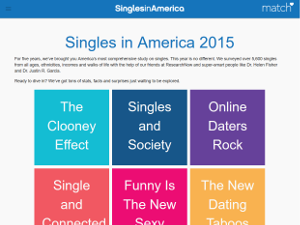
Match.com Singles in America 2015

For half a decade, Match.com has celebrated dating with America’s most comprehensive study on singles. This year's annual analysis surveyed 5,600 singles from all ages, ethnicities, incomes and walks of life. What it found is a new dating landscape that's laying tired stereotypes to rest.

The days of macho men and dependent women are history. Men are increasingly seeking out independent female partners and women are setting the tone in relationships. The 'Singles in America' study calls it “The Clooney Effect.” According to the study, the majority of single women in 2015:

  • Want a partner with a sense of independence (89%)
  • Want a partner with the same level of intelligence (86%)
  • Think it's ok to casually date more than one person at a time (74%)
  • Are not willing to support a partner financially (55%)
  • Seek a partner who's comfortable with their sexuality (94%)
  • Would not likely date someone who's less intellectual (61%)

The Right Time To Have The Big Talks In Your Relationship

Studies
  • Friday, December 18 2015 @ 10:11 am
  • Contributed by:
  • Views: 1,165

If honesty is the best policy, is there an optimal time to divulge your most personal information?

Even at the best of times, “The Talk” can be a touchy subject. Maybe you want to date exclusively. Maybe you have wedding bells on the brain. Maybe you're just ready to disclose a weird hobby or an annoying habit.

Whatever talk you're ready to have, it's a sensitive situation and tricky to get the timing right. To shed some light on the murky topic, online dating site Zoosk polled more than 5,000 users to get their thoughts on having uncomfortable relationship conversations.

The big question on most daters' minds is this: when is it ok to define the relationship as exclusive or nonexclusive? According to Zoosk's survey, almost half of men believe it's important to define the relationship within the first few dates. Only a third of women agreed. Forty-nine percent of female users wanted to wait until after the first few months of dating to discuss exclusivity.

As far bigger commitments go, 56% of men and 54% of women consider six months an appropriate time to talk about marriage. Note: the marriage talk in question isn't about marrying each other or picking out color schemes. This conversation is just about whether you aspire to get married at all.

Zoosk also asked users about disclosures earlier in the dating process. Their research found that response rates to the first online dating message increase if the following words are used: vegan, pets, allergies. On the other hand, response rates decrease with the appearance of these words: vegetarian, virgin, rich.

In that initial communication, more men (32%) than women (28%) say they would disclose if there was something unusual about them sexually. However, the majority of men (52%) and a significant number of women (41%) say they would prefer to remain in the dark about their date's number of past sexual partners.

On or immediately following the first date, 70% of men say they would be upfront if they are seeing other people. Sixty-two percent of women say they would do the same. Past partners, on the other hand, are a subject better saved for later dates. Nearly half of men and women say they do want to discuss former relationships and recent breakups, but only after a few weeks of dating.

For more about this dating service please read our review of Zoosk.

Do Matching Algorithms Actually Work?

Studies
  • Friday, December 11 2015 @ 07:03 am
  • Contributed by:
  • Views: 1,945

Online dating services like eHarmony and Chemistry.com have long emphasized their ability to find “quality” matches based on matchmaking algorithms. Even dating app Tinder, known as more of a hook-up app than a true matchmaking service, is getting in on the long-term love strategy. The company just released a new version, with updated algorithms that Tinder CEO Sean Rad maintains will lead to “more meaningful matches.”

Matching algorithms work like this: If you craft a profile with your interests, hobbies, income, and other descriptors, and you identify the qualities you are looking for in a match, then voila – the online dating site will find those candidates best suited for you. In other words, they will find people with similar preferences, interests, and backgrounds and match you together.

Which means that there’s a higher likelihood of the two of you falling in love and living happily ever after, right?

Not necessarily. Some writers point to research that says otherwise. As The Washington Post shared in a recent article: “Dating site algorithms are meaningless. They really don’t do anything. In fact, the research suggests that so-called ‘matching algorithms’ are only negligibly better at matching people than random chance.”

The reasons behind this conclusion are varied, but the basic idea is that chemistry between two people is highly variable. Just because you might match up well in theory, (and online), doesn’t mean that the spark will exist in real life. But the dating sites want you to believe otherwise.

There is an argument to be made that people who are considered “compatible” or who have the same background, communication style, or any number of factors in common might make better matches. And they might – or they might not. According to one very prominent study from 2012 conducted by Northwestern University’s Eli Finkel on the matching algorithms used by online dating sites, there was just as good a chance that someone you meet at random could end up being the love of your life.

According to Finkel’s study, relationship success depends on three things. First, individual characteristics, like whether you’re smart, funny, consider yourself beautiful, or avoid commitment at all costs. Second, the quality of interaction between two people - specifically how you hit it off in-person, not through text messages back and forth. And third, your surrounding circumstances, like your career, ethnicity, financial security, and health.

As we know from online dating sites, we aren’t always accurate or truthful when we are describing ourselves, so it’s likely we aren’t as compatible as we think. Another problem is that compatibility isn’t the marker of a good relationship. It really comes down to that elusive thing called chemistry and how you interact together in person.

With this information, it’s to every dater’s benefit to accept more invitations and matches, even those who don’t seem to be suited for you. Because the truth is, until you meet, you just don’t know.

This Is What Science Has To Say About Your Dating Dealbreakers

Studies
  • Sunday, November 15 2015 @ 09:05 am
  • Contributed by:
  • Views: 1,924

Even the most open-minded dater has dealbreakers. Maybe it's bad manners. Maybe it's selfishness. Maybe it's talking too often about an ex or refusing to put the toilet seat down.

Most of us could make a list of the positive qualities we're looking for in a mate and a list of the negative qualities that will send us running. If you've spent any amount of time reading dating advice, you've been told that the best way to find a partner is to focus on what you do want rather than what you don't.

But now, new research suggests that people give more weight to their dealbreakers than they do to their deal makers. According to The Wall Street Journal, this tendency is essentially “the relationship version of the economic loss-aversion theory, which holds that people prioritize avoiding risk over acquiring gains.” People pay more attention to what's wrong with a potential partner than what is right.

In a series of six studies published together in October in the Personality and Social Psychology Bulletin, researchers from several universities found that women have more deal breakers than men. This is most likely because the stakes are higher for childbearers, who must be pickier about choosing a mate.

The studies also found that people who believe they are a good catch have more dealbreakers, and that everyone has more dealbreakers when considering a long-term relationship rather than a short-term one. One of the studies found that, though women tend to have more dealbreakers than men, there are more similarities than differences between the sexes.

The biggest dealbreaker for both was “disheveled or unclean,” followed by “lazy” and “too needy.” Women place greater importance on having a sense of humor, perhaps because humor is linked to intelligence. Men aren't as concerned about brains in a mate – in fact, one study found that men prefer not to date women who are smarter than they are.

When it comes to hitting the sack, the sexes are divided again. Women consider “bad sex” to be the biggest dealbreaker. Men, on the other hand, are more turned off low sex drives and talking too much. It's a classic dichotomy – men want quantity, women want quality.

A discusssion of dealbreakers begs the question: are you too picky or not picky enough? And which is better? Psychologists and dating experts say it's smart to set reasonable standards and expectations, but relying on irrational ones could mean missing out on a great mate.

If you want to know if a dealbreaker is reasonable or ridiculous, try this tip from Michael Boman, a licensed clinical social worker in Magna, Utah, who counsels couples: “Ask yourself what your best friend would say. It helps you to become objective.”

Page navigation