Social Networks

Meet MeetMe, A New Take On Social Dating

Social Networks
  • Tuesday, November 19 2013 @ 07:52 pm
  • Contributed by:
  • Views: 2,118

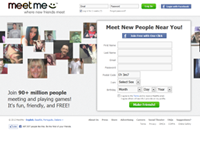
Anything with a cutesy smiley face in the logo has to be good, right? Or maybe that's just my inner 13-year-old girl talking. Either way, when I discovered MeetMe.com and its accompanying kitschy logo, my curiosity was piqued.

MeetMe calls itself a social discovery application that connects members through games and apps on the web and mobile phones. MeetMe was initially founded under the name myYearbook by two high school students, Dave and Catherine Cook, and their older brother Geoff, during Spring Break of 2005. Following humble beginnings at the suburban New Jersey high school they attended, myYearbook partnered with game developer Arkadium to bring Flash based games and a virtual currency, called Lunch Money, to the site.

After that, there was no stopping the site's momentum. An entire virtual economy developed from the Lunch Money currency, including the ability for members to donate to their favorite charity using the Causes application. The site added Meebo instant messaging to provide real-time chat and Chatter, a real-time stream that incorporates media sharing and gaming. Games available inside the stream include Ask Me, Rate Me, and 2 Truths and a Lie.

myYearbook made further efforts to improve its members' experiences by launching applications for the iPad, iPhone, iPod, and the Android operating system. It also rolled out a new site design in 2010 that was created by crowd sourcing ideas from the site's members. Finally, in June of 2012, the site was renamed MeetMe and its current incarnation was born. With its fresh focus on introducing new people instead of reconnecting old acquaintances, MeetMe has seen a great deal of success.

Where MeetMe really excels is making the meeting process fun. There are matches and search options just like typical dating sites, but MeetMe has many more entertaining things to offer. Users can ask each other questions and follow a continuously updating live feed that features the answers of other local members. There's also a blind date game for braver souls, and a game called "Owned!" in which you can buy and sell friends using Lunch Money (and earn half the profit when you sell someone or your photo is bought).

Of course, there is also no shortage of more traditional games for users to play. You name it, it's there. Arcade games, casino games, word games, strategy games, card games...everything you could ever want to play is available, from air hockey, to blackjack, to a Pac-Man knockoff, to crossword puzzles and solitaire.

Admittedly, I'm not sure how a card game that's meant to be played solo can help you meet other people, but hey - at least you have the option.

To find out more about this dating service you can read our new review of MeetMe.com.

Will Facebook Graph Search Finally Make Online Dating Cool?

Social Networks
  • Monday, October 21 2013 @ 08:23 pm
  • Contributed by:
  • Views: 1,674

That's the question posed by Cliff Lerner, founder and CEO of SNAP Interactive, in a recent article on HuffPost.

Personally I like to think we've already decided that online dating is cool, but maybe I'm just trying to make myself feel better. Maybe the rest of the world isn't as on-board with the idea as the social and professional circles I run in. For those people, Lerner says, the launch of Graph Search could make all the difference.

When Graph Search was announced, online dating sites went a little bit insane. Some feared that because it could meaningfully connect singles through friends and common interests, it would mean the end of traditional dating sites. It even includes the option to search by "relationship status," making it clear that dating is a key element of the new feature.

"The concern," Lerner explains, "is that singles will gravitate more and more towards Facebook for their online dating needs since Facebook already has superior data and profiles and now is offering enhanced friend and interest-based search and matching functionality for singles."

But fear not, online dating sites, because Lerner also says that line of thinking "couldn't be more wrong."

Facebook's Graph Search could be a valuable opportunity for dating sites. Currently only 1 in 5 singles visit a dating site each month, and the biggest opportunity dating sites have for growth is to crush the stigma associated with them once and for all. The best way to get that remaining 80% of singles to log onto online dating sites is to make it seem as normal as possible.

Enter Graph Search, which subtly blends online dating functionality into the Facebook experience. With the addition of "social dating" to Facebook, a brand new crop of singles is being introduced to online dating in an understated, but effective, way. And once they get a taste of what it has to offer, there's a good chance they'll turn to online dating sites to get more out of the experience.

Voila - Facebook Graph Search might actually be doing the online dating industry a favor, not driving a nail into its figurative coffin.

"It's only a matter of time before the online dating industry says a huge "thank you" to Facebook for removing the online dating 'stigma,'" writes Lerner, "and thus enabling millions of more singles to enter the 'online dating' market, which will ultimately expose many new millions of singles to destination dating sites."

Facebook Updates Its Data Use Policy

Social Networks
  • Sunday, October 20 2013 @ 09:11 am
  • Contributed by:
  • Views: 1,234

In a move that will probably surprise no one, Facebook proposed updates to its Data Use Policy and Statement of Rights and Responsibilities for the millionth time.

In another move that will probably surprise no one, most users probably aren't even aware of Facebook's proposed changes.

And in a move that might actually surprise a few of you, Facebook allowed users to comment on the proposed changes and, after the commenting period closed, decided to delay the update as it deals with criticisms from privacy groups.

What? Facebook is being thoughtful, acting concerned about privacy, and taking others' feelings into account? Who are you and what have you done with Facebook?

Seriously, though, it's awesome that Facebook maybe cares a little bit about what its users actually think. Their announcement of the updates said that both the Data Use Policy and Statement of Rights and Responsibilities would receive new language that clarifies:

  • How advertising works on Facebook
  • What to expect when it comes to using your name, profile picture, content and personal info with ads or commercial content
  • How to control or remove apps you've used
  • What data you're sharing with mobile devices

The proposed updates were met with resistance from privacy groups, who asked the FTC to prevent Facebook from enacting the changes over concerns about how the social networking site handles user information for advertising. According to these groups, the new policy makes it easier for Facebook to use the data of its members for advertising without their consent.

"The Federal Trade Commission must act now to protect the interests of Facebook users," said a letter sent to the FTC and signed by officials from six groups, including the Electronic Privacy Information Center. "The right of a person to control the use of their image for commercial purposes is the cornerstone of modern privacy law."

The proposed new Data Use Policy states that Facebook will use the personal information supplied by users to provide more relevant advertisements. Unlike the previous Data Use Policy, which says "We do not share any of your information with advertisers (unless, of course, you give us permission)," the new policy says nothing about permission ("...we may use all the information we receive about you to serve ads that are more relevant to you."). It's a small change in language that means an awful lot.

Privacy groups now fear that actively giving permission is a thing of the past and that by using Facebook, your permission is automatically assumed. The real issue here is that companies like Facebook need to communicate in simple, plain language about how they handle users' data. Until that transparency is achieved, we have a long way to go.

Mixing Mediums and Messages

Social Networks
  • Thursday, September 12 2013 @ 07:03 am
  • Contributed by:
  • Views: 1,130
Nowadays, some online dating sites and apps are trying something new: instead of creating a brand-new profile, they just take information from your preexisting social media sites. For those who don’t like writing about themselves, this is something of a relief; they’ve already suffered through once, and that’s enough for them. However, before you sign up for one of these services, you might want to check what your social media actually says about you.

First of all, there’s the privacy issue. What, exactly, will this dating service pull from your social networks? Let’s say you had all your information set to friends-only - will you need to make certain information public for the app to work? Furthermore, if you didn’t want it public before, how comfortable are you with the same info being used on a dating site? For those who are vigilant about protecting their privacy, getting the answers to these questions is vital before signing up to a specific site, lest you reveal something you didn’t intend.

Next up is the content itself. If you have profiles on long-established social networking sites, there’s a large chance that your information is outdated and potentially cringe-inducing. Maybe your favorite quotes are no longer from that movie everyone loved to drunk-quote in college. Maybe your goals are no longer the same. Maybe you’re now embarrassed that you included your childhood paper route in your work history.

Yet another aspect to consider is social network sites that include pictures. These pictures might include some that are also old and outdated, or worse yet, have been uploaded by friends and don’t necessarily feature your finest moments. Perhaps they even feature past relationships. Granted, whenever you ‘friend’ someone on the social networking site, you’re giving them permission to see all this and more; however, you’ve probably at least met them in person by then and are prepared for that level of vulnerability. If you don’t normally make such pictures public, make sure you know what will be seen by potential dates.

On typical online dating sites, you’re encouraged to do ‘maintenance’ on your profile, to keep it fresh and interesting and ensure that it still creates the first impression you want. Before you sign up with a site that incorporates your social networking profiles, make sure you fully understand what you’re signing up for - and then make sure it sends an accurate, positive and up-to-date message.

Social Media Guidelines for Dating

Social Networks
  • Thursday, August 29 2013 @ 07:25 am
  • Contributed by:
  • Views: 1,445

Most of us are at least familiar with social media like Facebook, Twitter, FourSquare, and the like. Many of us have accounts and check them on a regular basis. Some of us keep privacy settings high while others put themselves out there to gain a larger client and networking base. Some feel compelled to post constantly - where they are going for dinner or what they just said to a work colleague, while others prefer to post only occasionally with meaningful advice or news.

We all perceive social media in different ways and use it for different reasons. This is why it can get tricky when you incorporate dating into your virtual mix.

Obviously, there are a lot of opportunities for connecting with other singles over social media. But reaching out to people virtually comes with risk. How do you feel about potential dates - and strangers - knowing so much about you through Facebook or Twitter before you even meet face to face?

Following are a few basic guidelines to remember when dealing with social media and dating:

Don't be afraid to connect. There are many dating tools that utilize the power of Facebook to connect you with people in your social circles that you don't necessarily know. Check out CoffeeMeetsBagel or TheDatable if you want to promote your other single Facebook friends in the dating pool. These apps are selective about the information shared, limited to your likes and profile photos.

Know your privacy settings. You don't have to make your social media posts public to everyone. It's important to know your privacy settings, especially on Facebook or Google+ where you can customize by post or picture. It's good to be aware of how you present yourself online to people who don't know anything about you. This goes not only for dating, but also for your career.

Don't post rants about your dates. Think about it - if you were interested in someone, friended him on Facebook, and then saw posts about how terrible his last five dates were, you might reconsider asking him out. Try not to scare off potential dates by making them think you'll write about them, too. Keep your dating life discussions limited to in-person gatherings with your friends.

Exchange numbers first. While it might seem easier to connect on Facebook and drop a casual message to someone you just met at a party, it's better to exchange phone numbers. When you let someone into your Facebook world too soon, they have access to all kind of information - your exes, where you went to school, those party pics from last weekend. People often draw inaccurate conclusions quickly. Instead, keep a little mystery and send a text instead. Friend him later.

Are We Getting Tired Of Social Media?

Social Networks
  • Wednesday, August 14 2013 @ 07:49 am
  • Contributed by:
  • Views: 2,140

Wake up. Scan your Facebook news feed. Check your notifications on Twitter. Post to your Tumblr. Favorite a friend's photo on Instagram. Share an interesting article on Google+. Add a pin to your newest Pinterest board. Update your qualifications on LinkedIn. Then check your email, blog, and online dating profile.

And that's before you've even had breakfast.

We're living in a social media-saturated world, and there's plenty of evidence to suggest that our obsession with digital connectivity has changed the way we relate to each other. Now, what started as a fun and ground-breaking way to meet new friends and keep in touch with old ones may be turning into a time-consuming chore.

According to a recent survey conducted by E-Score, consumer attitude towards social media could be shifting. While awareness and usage of social media sites continues to remain high, the allure of using them is starting to fade.

The survey identified the social media sites with the most consumer awareness, as well as the appeal of those sites. Facebook scored the highest for both awareness and appeal, with 140 million unique monthly visitors in the US. Twitter came in second, followed by Google+. Dating sites eHarmony and Match.com rounded out the top 5.

Though two online dating sites were among the top five most recognizable social media brands, they were also among the lowest when ranked by appeal. Online dating has overcome many hurdles since its inception, but it seems it still has a few to clear.

Both Facebook and Twitter also earned surprising scores. They are two of the most recognizable and popular social media platforms, but they scored unexpectedly low in the appeal ratings. The survey's findings suggest that these social media sites are either habit-forming (and I think few of us who use them would disagree with that) or viewed as a necessity rather than a pastime.

"During the past five years, the role of social media has shifted from a leisure activity to an integral and, at times, mandatory, part of our lives," said Gerry Philpott, president of E-Poll Market Research. Social media fatigue could be setting in as using social media sites becomes more about obligation and less about fun.

I don't think the fall of social media is happening any time soon, but it's an intriguing prospect. Will something we once thought was a positive addition to our lives become something we can't stand?

What do you think: are we experiencing social media burnout?

Page navigation