Customer Service

POF and Lavalife Founders Discuss their Former Rivalry and the Online Dating Industry

Customer Service
  • Friday, March 25 2016 @ 10:01 am
  • Contributed by:
  • Views: 1,835
Markus Frind on Disruptors

Last month on the Canadian TV show The Disruptors, an unlikely interview took place between host Bruce Croxton and Markus Frind, the founder of popular online dating site Plenty of Fish. (Broxton was the founder of dating site Lavalife, which raked in members until POF’s free service hit the market.)

For the first time, the two former rivals were sitting down together to discuss the current state of the dating industry, and the history of their two companies.

Broxton noted the quick success of POF, which because of its free service, quickly gained a lot of users – many of whom hadn’t tried online dating previously. Typically, dating sites made their money through selling subscriptions to members, but POF tried a different model to attract a larger audience, and it worked. Instead of selling subscriptions, the site made its money by selling ad space. After all, they had an engaged audience.

At its peak and before its sale in 2004, Lavalife had over four hundred employees. Frind launched POF in 2003 and operated the service alone from his apartment for the first five years, without hiring another employee despite the service’s rapid growth. He managed to turn it into the largest dating site in the world by focusing on the US market (even though he was based in Canada), and by keeping the service free despite the naysayers.

Frind’s experience wasn’t in the dating industry when he first thought of the idea for POF. In the interview, he admitted that he just needed to learn a new programming language and the best way to do that would be through creating a dating website.

Croxton was complimentary in the interview, admitting that Frind was incredibly innovative in the dating space, despite the endless number of dating apps launched in the last few years claiming to change the online dating industry. “I find it ironic because many of the tech ideas on the show really emphasize that it’s not about the technology anymore because you can be up and running very quickly, it’s really a marketing barrier to entry. But you were pioneering that back in 2003,” Croxon said.

Frind Agreed, noting that he sold his company (for $800 million) because he was tired: “There isn’t really much innovation in the dating space; the features we have today are the same features we had five years ago. It just got kind of boring and I wanted to do something new.”

You can watch the whole interview here. To find out more about POF you can read our review on Plenty of Fish.
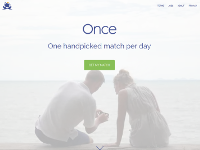
New Dating App Once Offers Personal Matchmaking

Customer Service
  • Tuesday, November 24 2015 @ 06:55 am
  • Contributed by:
  • Views: 1,723
Once

Looking for a new dating app? It’s not hard to find something besides Tinder – it seems a new dating app launches every week, each with its own particular spin. But the new U.K. launch of dating app Once has got my attention, because it offers something the other apps don’t – real human matchmakers in place of computer algorithms. (We are now going back to basics with online dating.)

Once works like this: once every 24 hours, users will get a hand-picked match to either decline or accept within the next 24 hours. Dates are carefully chosen using several criteria, including interests, looks and personal preferences.

With Once, there is no auto-swiping or endless browsing or location matching like you find on apps like Tinder because the match is personally curated. But it also means as a dater, you have to have patience, because you only get one match a day.  After all, the human matchmakers have a lot of other people to cater to, not just you, and this takes time.

But patience can work in your favor, and often leaves you more interested to tuning in and seeing who your featured match will be. Chances are, you’ll accept more matches when you don’t have an endless array of potential dates to choose from – and because it’s a bit more personal, instead of computer-generated choices. The thinking is that you and your hand-picked date will have some things in common, and the likelihood of relationship success will be greater. The jury is still out on this, as Once hasn’t been on the market long enough to see results.

The dating app recently launched in France, and managed to gain 100,000 users in only a couple of weeks. Once has now launched in the UK, where real-life matchmakers will be picking daters to match in London.

"People are fed up with having just to sit and swipe through hundreds of people in the hope that they might find one person who they like and then start a conversation with," said Jean Meyer, the CEO and founder of Once in an interview with Mashable. He also noted the time-saving aspect of his app: “With Once, we’re taking that responsibility on ourselves, and are handpicking great people for London’s time-starved daters.”

While Once is available in France and the UK on both iOS and Android devices, there is no news yet on the app’s roll-out in other countries. Perhaps this adds to its mystique, to keep daters guessing. Dating Sites Reviews will keep you updated as we learn more.

Tinder Offers New “Super Like” Feature in Latest Update

Customer Service
  • Tuesday, October 13 2015 @ 06:31 am
  • Contributed by:
  • Views: 1,202

Popular dating app Tinder, which many daters have described as a hook-up app, has decided to get a little more serious with its latest update. Instead of upping the volume of swipes, the management team decided to focus on encouraging users to be more selective, and is now offering a feature dubbed “Super Like.”

Instead of just swiping right when you like someone special (like all the other right swipes before), the new feature allows you to swipe up – or Super Like - one special match per day. When two people Super Like each other, Tinder reports that they tend to have conversations over the app that last 70 percent longer. (Tellingly, the company is rolling out this feature in the wake of Vanity Fair’s controversial article on the so-called “dating apocalypse” fueled by Tinder, which ended in a Twitter rant from Tinder co-founder Sean Rad.)

Tinder is definitely getting its new more serious message across in marketing campaigns, including a video the company made highlighting the Super Like feature, which is targeting female daters. In the video, a woman is being harassed by a bunch of men who are trying to flirt with her, and she’s not interested. So to save herself from their aggressive tactics, she Super Likes a nice guy on the app. In other words, she is saving herself from the awful herds of pushy guys on Tinder by using Tinder’s latest feature.  

Will it be effective for Tinder to appeal to women? It is still by far the most popular app, but other developers are using Tinder’s hook-up reputation as a reason to choose another app. So Tinder is fighting back.

The new feature is a way to make women feel safer. But more than likely, it is also a response to Bumble, a rising star in the dating app world that has been getting a lot of attention.

Bumble is a female-centered dating app that looks like Tinder but gives the messaging power to women by having them make the first move. Coincidentally, Bumble was also founded by one of Tinder’s co-founders Whitney Wolfe, who sued the company and subsequently launched her own dating app. This past week, Wolfe made an appearance on The Daily Show, in which she answered questions about how her app is changing the world of online dating by putting women in the seat of power to ask the men out.

It’s great that daters have more options, and the competition from apps like Bumble means that Tinder will continue to improve its offerings. And that’s always a plus.

Coffee Meets Bagel in Hot Water Over Ill-Timed Tweet

Customer Service
  • Wednesday, July 08 2015 @ 06:51 am
  • Contributed by:
  • Views: 1,329

On Sunday June 14th, people across America were acknowledging Flag Day, an annual tradition, over social media. Coincidentally, it was also the annual celebration of the LGBTQ community – an event known as Pride. So when Coffee Meets Bagel reached out via social media to announce its support of Flag Day, the online dating service mistakenly caused an uproar because of a typo.

The now-infamous tweet which was widely criticized over social media and the subject of a story in the Washington Post, said: “It’s Fag Day. Hoist your colors and don’t forget to LIKE today’s Bagel.”

People on the East Coast were the first to catch the mistake, but many didn’t realize it was a typo and immediately took to Twitter to denounce the dating service, with one person posting: “Got a notification from @coffeeMbagel saying today was "fag day." I'm disgusted at the audacity to say that during pride. #coffeemeetsbagel.”

Many people weren’t aware of Flag Day, but they were aware of Pride celebrations, which made the typo even worse. They thought the company had posted the tweet on purpose.

Coffee Meets Bagel took down the post after they realized the typo. But thanks to the speed at which social media can influence a story, and the incredibly bad timing that the typo happened during Pride, the company had little chance to correct the error. They have since been apologizing and repeating that it was just a simple mistake.

About three hours after the notification went out, users received an e-mail from the company’s head of customer experience apologizing for the misspelling. It reads, in part:

“I would like to apologize wholeheartedly for the message you received this afternoon. The misspelling of Flag Day was a mistake and a complete oversight. We’re updating our process to ensure something like this does not happen again…Coffee Meets Bagel, as a company and as individual employees, celebrates the LGBTQ community and would never use such a word.”

While it might just be a simple oversight, the bigger question is: will it hurt CMB in the long-run, if people associate their brand with a lack of support of the LGBTQ community?

We have all sent emails and social media posts with typos – this isn’t uncommon. What is a shame in this instance is that a company sent an official tweet meant to show support of both Flag Day and the LGBTQ community, and yet, ended up alienating their customers and potential customers in the process.

Tinder announces spam is down 90%

Customer Service
  • Thursday, April 16 2015 @ 06:39 am
  • Contributed by:
  • Views: 2,043

Have you ever swiped right on a Tinder match only to discover her profile isn’t real? Since the famous dating app partnered with mobile identity company TeleSign, it claims spam is down as much as 90%.

Spam has been a growing problem for Tinder– prostitutes masquerading as potential love matches eager to sell their services, hackers using the dating app to obtain valuable user information, and even companies like The Gap aiming to capitalize on the 18-25 market with clever marketing campaigns. (Last month they set up their campaign ads as Tinder user profiles without explicit permission from the company – and were asked to take them down.) Also, there was the incident of a hacker tinkering with their API to match straight men with other straight men, which ended up confusing and embarrassing a lot of users.

Even though Tinder verifies people through their Facebook accounts, many people have become adept at creating fake social media accounts, too. So Tinder’s new deal with Telesign seems to be alleviating the problem.

Telesign works by analyzing massive amounts of real-time and historical data on phone numbers, including associated contact information, phone types, geographies, and carriers. Their technology uses PhoneID verification to determine how potentially risky a phone number is, and whether the number really belongs to the person creating the account. If the score is high (meaning high risk), the user is blocked. Telesign also recommended that Tinder implement rate limits. This means that Tinder can set a limit for the number of accounts created using the same phone number. The companies did not say whether the analyzed information from Tinder users is kept private, or how it could be used by TeleSign or Tinder.

Ryan Ogle, Tinder’s CTO said in a statement: “Once we had TeleSign in place, we were able to block fraudulent accounts in a much more sophisticated way. It’s been 100 percent accurate and we’ve seen about a 90 percent reduction in spam traffic as a result, from day one.”

Tinder has taken other steps to cut back on spammers, including limiting the amount of swipes people can do in a 24-hour period with the free service. If they want to swipe indefinitely (as spam bots often do), they will have to pay for Tinder Plus.

This is another big step for the company, which seems to be making significant changes in recent months. IAC, the parent company of Tinder, has brought in a new CEO, and in March, Tinder rolled out its first paid service, Tinder Plus.

Check out our review of Tinder for more information on this popular dating app.

Sean Rad goes on Reddit to answer questions about Tinder

Customer Service
  • Sunday, April 05 2015 @ 11:27 am
  • Contributed by:
  • Views: 1,583

To help promote the global launch of Tinder Plus, co-founder and soon-to-be former CEO Sean Rad has been in the news a lot lately. Recently, he hopped on Reddit to answer questions from the general public about Tinder, the launch of its new premium service, and what’s next for the company.

Because of the recent backlash about Tinder Plus, people were interested in the reasons behind the pricing of the new service - $9.99 for those under 30, and for those 30 and older, $19.99. According to Rad, “months of testing and thought went into the feature and price mix for Tinder Plus. We tested a broad range of prices and found that users that saw value in Tinder Plus were more than willing to pay at the existing price points.” He goes on to talk about Passport and Rewind, the two most-requested features offered in the new service, which allow you to check out people in other cities and also to reconsider someone you rejected before.

Rad also fielded questions on whether the app creates feelings of rejection – after all, you can be rejected with one swipe in less than a second on Tinder. Rad countered this question by explaining how Tinder works. People won’t know that you liked them unless they swipe right on your profile. “We call this the ‘double opt-in.’ Even if you don’t match with another user, there’s no certainty that they saw your profile.”

Tinder’s history holds a series of lucky accidents – for one, it was almost named Matchbox. The first version of the app didn’t even have swiping, Tinder’s signature feature. Co-Founder Jonathan Badeen explains: “I snuck it in a few weeks later and told everybody after it was released that they could swipe. The swipe was born out of a desire to mimic real life interactions with a card stack. When organizing cards you put them into piles. Swiping right fittingly throws the card in the direction of the matches…The swipe just made sense in this case and seems stupid simple in retrospect.”

One of the participants asked how the founders came up with the idea of Tinder, to which Rad replied: “…we had this obsession with breaking down the barriers in meeting people around you. We noticed that people grew closer to their small groups of friends but grew farther apart from the rest of the world in the process. We knew that if we could simply take the fear out of meeting someone, that we could bring the people closer together. And we've done just that.”

Please read our Tinder review for more information on this popular dating app.

Page navigation