Industry

Dating Apps Try and Entice Young Women to Return

Industry
  • Tuesday, June 18 2024 @ 12:32 pm
  • Contributed by:
  • Views: 899

Dating apps are struggling right now, and many Gen Z women are looking to other platforms like LinkedIn and Instagram to meet people.

A new article in The Financial Times cites a poll from Mintel that found that 47 percent of men between 18 and 34 had used a dating app or website to meet someone this past year, compared to only 25 percent of women of the same age.

“Trying to engage young women is the biggest struggle for dating apps,” said Rebecca McGrath, associate director for media and technology at Mintel. “Significant gender skew means it is harder for men to find matches and, subsequently, women often become bombarded, making the experience worse for all.”
Grindr’s New Chief Privacy Officer Responds to Controversy Over App’s Practices

Industry
  • Monday, June 10 2024 @ 02:29 pm
  • Contributed by:
  • Views: 1,128

Grindr’s new Chief Privacy Officer Kelly Peterson Miranda is setting the record straight regarding the app’s privacy policies and use of personal data following allegations and a recent lawsuit.

The interview with The Record Media takes place in the wake of several allegations that Grindr has violated user privacy rights when it comes to their personal data.

The LGBTQ dating app was sued in April for allegedly sharing the HIV status of its users with third parties without their consent. Before that, its former privacy officer Ronald De Jesus has said that the company stored user data, including photos and videos, even after people deleted their accounts, which violated the app’s privacy policy.

And last year, the Electronic Privacy Information Center appealed to the Federal Trade Commission to investigate Grindr for its history of abuses.

Match Group Looks to Hinge as Rising Star

Industry
  • Wednesday, May 29 2024 @ 01:09 pm
  • Contributed by:
  • Views: 924
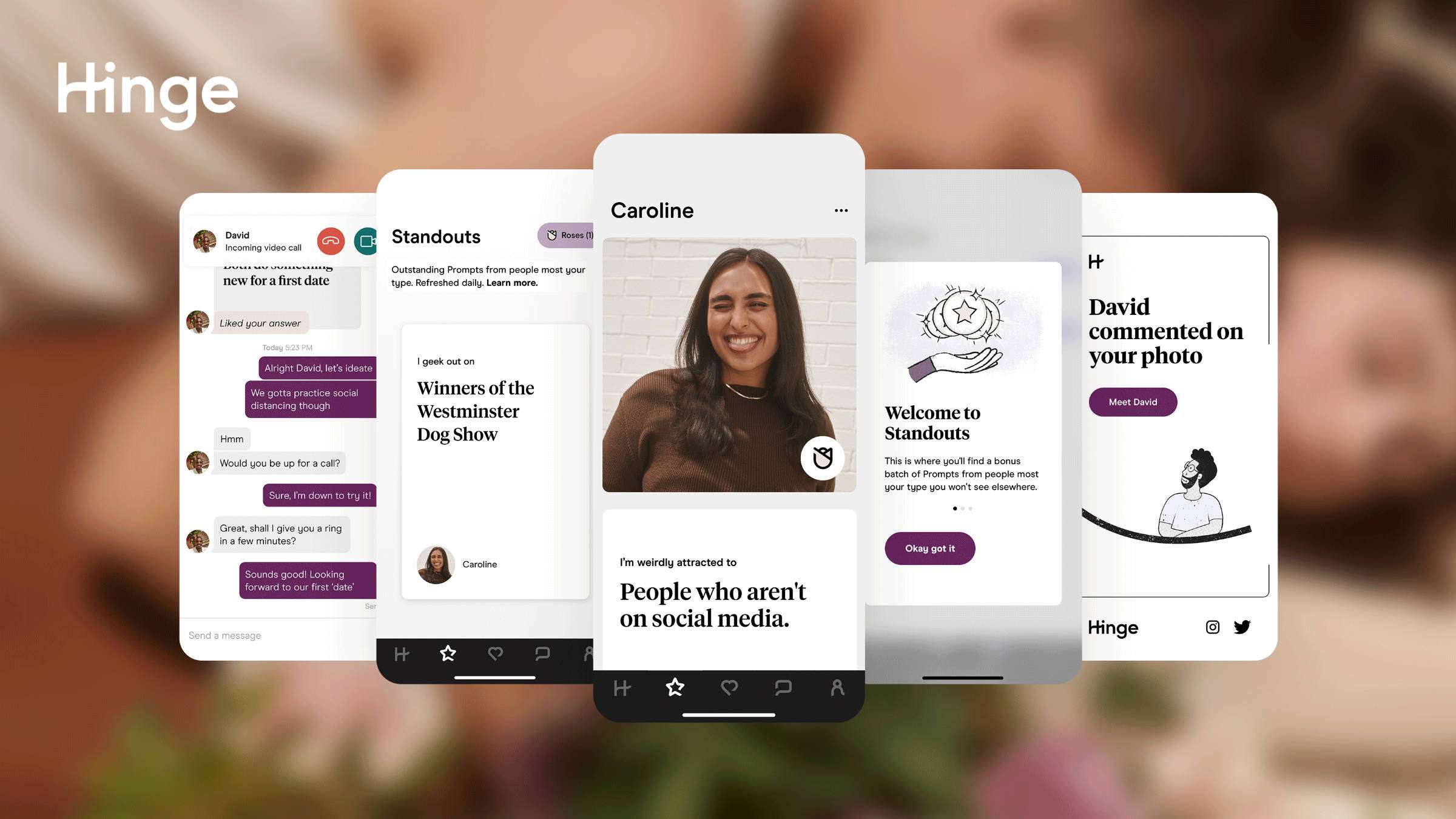
Hinge is a Rising Star
Image: Hinge

Match Group announced in its first quarter earnings report that Tinder’s paying users were down for the sixth quarter in a row, but Hinge’s paying users continue to rise.

According to Tech Crunch, Hinge has seen a whopping 31 percent increase in paying users year over year, now up to 1.4 million. This is far less than Tinder’s 10 million paying users, but as Tinder continues on its downward trend, its paying users dropping 9 percent from this time last year, Hinge offers a beacon of hope.

Dating apps in general have struggled in the last year, and companies like Match Group and Bumble have been trying to address it with more exciting paid features and additional security protocols, like Verification on Tinder. However, dating app users continue to drop their subscriptions and opt not to pay for features, especially younger users who are turning to free platforms like social media apps to connect.

Tinder’s Paying Users Continue to Drop in First Quarter

Industry
  • Friday, May 24 2024 @ 02:14 pm
  • Contributed by:
  • Views: 895

Dating app Tinder continues to lose paying subscribers according to Match Group’s latest earnings report. Match Group’s overall revenue for Q1 has been impacted by Tinder’s ongoing struggles, but it continues to hold strong in the dating app market overall.

According to Fast Company, Match Group said that Tinder’s paying user base for the first quarter fell 9 percent from the same quarter last year. The company’s CEO Bernard Kim remained optimistic, saying that they expect to slow user declines in the second half of the year.

However, Match Group’s revenue is up, with net income at $123.2 million for the first quarter of 2024 compared to $120.8 million this time last year, according to Marketwatch. Revenue rose 9 percent for the company to $859.6 million, compared to $787.1 million the same time last year. (Match Group revenue also beat overall analyst expectations of $855.8 million.)

FBI Issues New Scam Warning for Dating App Users

Industry
  • Wednesday, May 15 2024 @ 04:12 pm
  • Contributed by:
  • Views: 1,180
FBI Warning about Scams on Dating Apps

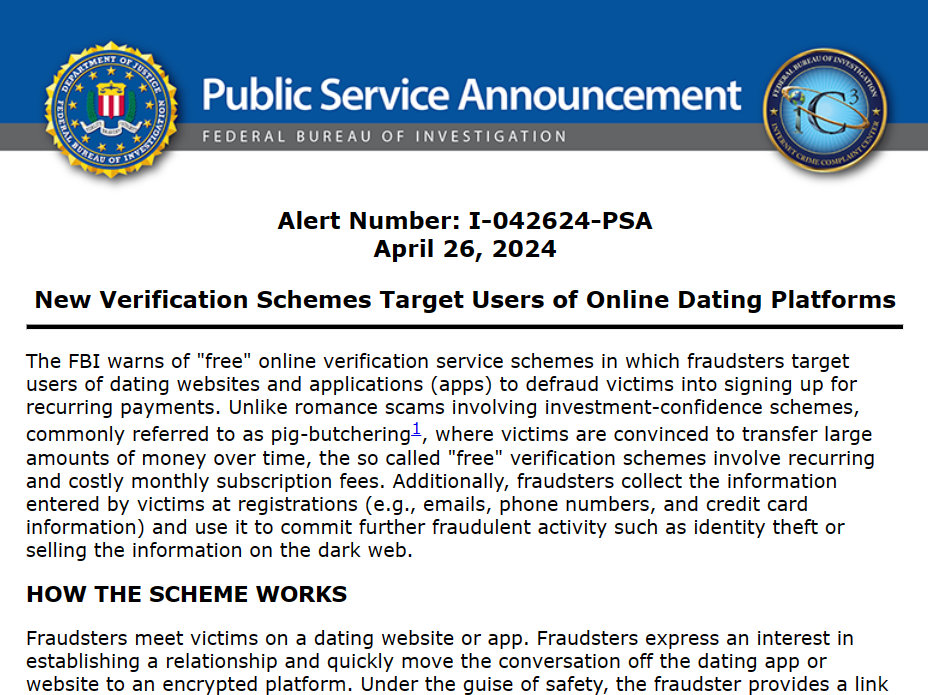
The FBI has issued a new warning for dating app users about a scam that involves “verification,” which raises more problems for the platforms as they roll out new safety features.

Scammers have been targeting people signing up for dating apps by asking people they match with to verify their identity “for safety reasons.” They share links to websites to get them off the platform, where they can steal the victim’s money and private data, such as credit card information.

The fake website looks real to users, displaying “fake articles alluding to the legitimacy of the website,” according to the FBI’s announcement. The verification website prompts the victim to provide their name, phone number, email address, and credit card number to “complete the process.” When the victim submits the information, they are led to another dating website charging monthly subscription fees.

Grindr Sued Over Sharing HIV Information with Advertisers

Industry
  • Friday, May 10 2024 @ 07:51 pm
  • Contributed by:
  • Views: 1,210

Dating app Grindr has been sued in the U.K. for allegedly selling the HIV status of its users to third parties.

According to the BBC, the claim was filed in London’s High Court, and alleges that “covert tracking technology” was used to track and illegally share the personal health status of users with advertisers. More than 650 claimants were affected along with reportedly thousands of other U.K. users.

Sharing personal and sensitive data of users with third parties without their consent is illegal in the U.K.

The lawsuit says the information shared with third parties includes the ethnicities and sexual orientations of users. It also says the sharing of such information took place primarily before April 2018, though some data was shared as recently as April 2020. The lawsuit specifically names two companies which help app developers analyze user engagement, Apptimize and Localytics, as involved third parties with access to the data. The lawsuit also claims that these outside firms might have retained some of the sensitive data for their own purposes.

Page navigation