Dating

Dating in America Today, According to Match.com and Zoosk

Dating
  • Sunday, March 08 2015 @ 08:48 am
  • Contributed by:
  • Views: 3,047

Now that Valentine’s Day is behind us, many will forget the flowers and pink hearts lining the stores. But they won’t stop dating.

In fact, there are more studies than ever about the state of dating today – starting with Match.com’s annual survey of singles across America. Match found that daters were pretty optimistic, especially guys. More men than women believe in love at first sight, (and more women than men are afraid of commitment). 

Match.com also reveal women prefer their independence, much more than men do. Ninety percent of women want more personal space, 93% want to pursue their own hobbies and interests, and 64% want more time with friends. Most women prefer to wait 1-2 years before moving in, whereas men prefer to move faster – 6-12 months of dating before shacking up.

Also, there is something Dr. Fisher calls “The Clooney Effect” taking place. That is, men are going for intelligent, powerful women. 87% of single men would date a woman who makes ‘considerably more’ money and who is considerably better-educated and more intellectual than themselves; 86% seek a woman who is confident and self-assured, and 39% would also make a long-term commitment to a woman who is 10 or more years older.

So what’s holding you back ladies? It seems like you are in the driver’s seat when it comes to establishing a new relationship. “Technology is dramatically changing how we court, but it can’t change the brain systems for romance and attachment. And today’s singles are setting a high bar for courtship and marriage,” said Dr. Helen Fisher, anthropologist and lead researcher for Match.com’s study.

Zoosk has also come out with a study about the habits and preferences of online daters, so we can get a better picture of what singles are looking for. According to its figures, women like outdoor types – guys who posted pictures hiking, biking and other outdoor activities received 19% more messages than those who didn’t.

Also, selfies aren’t a great thing to use, unless you are expert with the camera. Women who took selfies received 4% more messages, while guys who posted selfies took a hit – they received 8% fewer messages. But the women who took full-body selfies? They received a whopping 203% more messages.

In both studies, men and women both preferred people who had a grasp of good grammar and spelling. If you chose to answer messages with “cuz” “im” or “u” – on average, you received 13% fewer messages on Zoosk. Match.com revealed this was the number one turn-off for daters (even over text), with 54% of women and 36% of men agreeing.

So if you’re looking for love in 2015, put a little time and effort into your search, and keep a positive outlook – you are in good company!


How Dating Apps Rate Among Users

Dating
  • Thursday, February 26 2015 @ 10:12 am
  • Contributed by:
  • Views: 2,247

More than one in ten Americans have used a dating app or online dating service of some kind, according to a recent study from Pew Research. And dating apps are only increasing in popularity.

But despite peoples’ love of technology, online daters don’t seem to be finding what they want, and are not so satisfied with the dating app experience. No matter how many new apps hit the market, it seems the inherent problems with online dating (lying, old photos, bad behavior) – are still lingering, and affecting the overall user experience.

People tend to be more critical of dating apps than any other type of app, according to a recent report from Applause, which aggregates app ratings.

According to their report, dating apps consistently rank lower than almost any other kind of app available in stores to download. According to MarketWatch, “while the average app quality score in the U.S. is 67 out of 100 points across all categories, for dating apps, that number is 42 out of 100 — the lowest average score across categories.” The study looked at 53 different dating apps, all of which had more than 1,000 reviews.

While many people may blame apps for their poor online dating experience, the fact that the overall market is leaving people unsatisfied is telling. Online dating is a business, but one that involves people – who can be unpredictable and emotional, especially when it comes to dating.

For one thing, the currency of dating apps are people, so these apps must have a large database with a variety of choices to even compete with some of the major players like Tinder. If people receive the same matches over and over, or somehow “run out of options,” the dating app can be perceived as less valuable than other dating apps. Also, if a dating app user doesn’t like his matches, he’s likely to give it a lower rating, as opposed to others who have a good or even mediocre experience.

Of course, there are other things to consider when it comes to why dating apps aren’t faring so well among users. Some are annoyed with having to pay for special features, or when in-app advertising interrupts the service itself.

Surprisingly, Hinge and eHarmony – two online dating apps that emphasize the quality of their matches – scored low on overall user satisfaction, at least according to their ratings. They both earned an average score of 22 out of 100, and ranked as two of the 10 worst dating apps. OkCupid however, earned 62 points out of 100, putting it in the top 10 category with Skout and Let’s Date. Tinder ranked in the top 20, despite the many complaints and its reputation for being a “hook-up” app.

So what does this mean for online daters?  I guess we’ll have to see how dating apps evolve.

Happy Couples Are Probably Just Tricking Themselves Into Believing They're Happy

Dating
  • Tuesday, February 24 2015 @ 06:24 am
  • Contributed by:
  • Views: 1,243

Here's a post-Valentine's Day reality check: happy couples may not be happy at all, just really good at deluding themselves.

Publications like Cosmo would have you believe that the secret to romantic success is seeing your partner as they truly are. And it does sound nice, but psychological research suggests it's the wrong approach. Instead, the key to a happy relationship is seeing your partner as you wish they were.

Just think about it for a second and suddenly it seems obvious: of course someone who believes their partner lives up to everything they've ever wanted is more satisfied with their relationship. How could they not be? Sure, they may be deceiving themselves, but can we say it's wrong if it works?

A study on the subject was published a few years back in the journal Psychological Science. A research team from the University at Buffalo and the University of British Columbia gathered together 200 couples who came to a courthouse in Buffalo, NY, to get marriage licenses. Then, twice a year for the next three years, the researchers questioned each person individually about themselves, their partners, and their visions of an ideal partner.

Afterwards, the answers were analyzed for certain patterns. The researchers sought out people who idealized their partners – those whose descriptions of their partner's traits matched their descriptions of their fictional perfect match (even if their partner did not self-report seeing those traits in him- or herself).

"If I see a pattern of traits that are more positive than what my partner says about themselves, that's what we mean by idealization," explains Dale Griffin, one of the study's co-authors. "That is, there is a correlation between my ideal set of traits and what I see in my partner that she does not see in herself."

Each time the researchers checked in with the couples, they also gave them a survey designed to measure relationship satisfaction. All couples reported a decline in happiness over time, but those who held positive illusions about their partners experienced significantly less of a decline.

The Psychological Science paper reports that “People in satisfying marital relationships see their own relationship as superior to other people's relationships” and that they also “see virtues in their partners that are not obvious to anyone else.” In fact, it gets even more extreme: “People in stable relationships even redefine what qualities they want in an ideal partner to match the qualities they perceive in their own partner.”

In other words, it's ok – and maybe even better – that love is a little blind.

High There – A New Dating App for Weed Lovers

Dating
  • Friday, February 20 2015 @ 06:32 am
  • Contributed by:
  • Views: 2,891
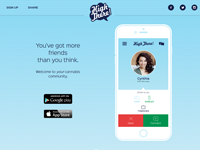
High There Dating App

It was only a matter of time before a Denver-based app developer would take advantage of the city’s new legalized pot industry. High There! - a new dating app specifically for weed lovers, launched this month for Android and will be debuting in the iTunes store soon. In addition to the mile-high city, the app is also available in 23 states that have legalized medical marijuana laws.

High There has been described as “the Tinder of pot smoking,” although instead of matching according to proximity and age preferences, the app asks for your weed preferences, such as vaping or smoking, and what your energy level is when you are imbibing – “low energy couch potato or high energy explorer,” according to a report on Mashable.

The design of the app is similar to Tinder, with photos as the main feature and the ability to accept or reject a match by swiping left or right. Besides how you consume your pot, a few extra questions are added to enhance your profile, including what you are in the mood for – “go out, stay in, or chat?” and your interests (“culture, outdoors”).

CEO Todd Mitchem says he was inspired to create the app after his date called it quits when she found out he smoked pot. It wasn’t the first time it had happened, so he decided he’d rather only date pot smokers – but needed a way to meet them. He wanted to build a community around people who might otherwise feel shunned for their habit. He told Mashable that the app “can also act as a kind of social network for smokers who are seeking recommendations on local dispensaries, to share tips or just make friends with other like-minded folks.”   

High There however is not the first dating app to cater to this particular clientele. My420mate launched last year, and 420Singles has been offering their pot-friendly app for a while as well, though High There seems to be getting a lot more attention in the press.

So far, the reception to High There has been mixed, according to reviews in the app store. The main reason for users’ frustration is that they download the free app and then can’t use it because of the marijuana laws in their particular cities. (If it isn’t available to purchase legally in your town, you can’t use the app.) Many people complain that they do have medical marijuana cards from another city, but can’t use the app because of the legal status in the city where they live.

High There is free and available for Android users, and will soon be available for download from the iTunes store.

Looking for Last-Minute Help on Valentine’s Day?

Dating
  • Saturday, February 14 2015 @ 11:16 am
  • Contributed by:
  • Views: 1,210

Luckily, we live in the age of technology – so if you forgot to make plans for Valentine’s Day (and unfortunately it lands on a Saturday this year) – you might want to look to the app store for help.

If you are looking for a last-minute gift or card, here are some apps to try:

Red Stamp Cards - Need a thoughtful Valentine's Day card in a hurry? Snap a photo and you can quickly create a unique card for your Valentine with this free app. Cards can be tweeted, texted, emailed or posted to Instagram and Facebook.

BloomThat - If you forgot to order flowers and the local grocery store’s selection looks a little tired, this app can help you out of a last-minute problem. (And they can deliver their hand-crafted bouquets via bicycle in under 90 minutes, as opposed to florists where there is an 8-hour delivery window.) For iPhone users only.

Users Unhappy With Tinder Changes, Sparks Outrage in App store

Dating
  • Friday, February 13 2015 @ 09:37 am
  • Contributed by:
  • Views: 1,649
This month, Tinder began rolling out its new premium service Tinder Plus in select European markets, and the feedback hasn’t been good.

The popular dating app surged to the top of the online dating market when it launched in 2012, attracting users who had never thought of signing up for an online dating site. Its easy-to-use format and free game-like service offered more entertainment than dating stress, and users flocked to check it out.

But in an effort to make money from this hugely successful endeavor, it was only a matter of time before Tinder’s owners developed a paid model for the app – opting for a premium service over adding distracting in-app advertisements. (Although the company has strategically lent its brand to marketing campaigns, like Gillette’s facial hair survey and Domino’s Pizza Valentine’s Day campaign.)

But Tinder Plus has not been greeted favorably, at least in its initial roll out – and the free service is suffering as a result. Although Tinder Plus is not set to launch in the U.S. until March, and prices are still to be determined, the company needs to find a new strategy - considering the backlash it has gotten in markets where the roll out has already taken place, such as the U.K. Tinder users who are not opting to pay for Tinder Plus and want to stick to the old free version of the app have been leaving bad reviews in the iTunes store (enough to drive the free service’s rating down to one and a half stars).

The problem has to do with new restrictions to the free service. Once a user has swiped a certain number of times, they are blocked for 24 hours from seeing any new profiles, unless they want to pay for the new Tinder Plus service. Since most users log in to Tinder multiple times a day to swipe through matches, this puts a serious hindrance on Tinder’s competitive advantage. Other dating apps that have restrictions on the number of profiles a user can see per day – like Hinge - have been easing up on their requirements, and seeing a surge of new downloads as a result.

With all the promising new free apps coming on the market, such as Bumble (started by an ex-Tinder employee), Tinder will need to think outside the box to keep its market share. After all, any online dating app or site’s currency is their user base. If Tinder loses theirs, then they stand to lose a lot more than the revenue from the premium service. Perhaps they should stick to advertising deals, or instead of taking away features from loyal users, offer more enticing new features.

Page navigation