Communication

5 Reasons Online Dating Isn't Working For You

Communication
  • Wednesday, March 23 2016 @ 07:12 am
  • Contributed by:
  • Views: 1,266

Imagine you're a recent college graduate. You're excited, nervous, naïve, courageous. The whole world is in front of you, waiting to be explored.

Then reality sets in. Leaving college means finding a job, owing rent, dealing with health insurance, and paying off student loans. Before long, you're daydreaming about the blissful days before the cap and gown.

Sound familiar? Online dating can be a similar experience. You sign up with all the excitement and naivete of that new college grad, but over time you become disillusioned. Messages go unanswered. Mutual matches aren't made. Dates are postponed and canceled. What good is online dating if you aren't actually going on dates?

There may be very real reasons you're not getting the dates you hoped for – some obvious, others more obscure. Before you give up on it for good, take a look at these 5 reasons online dating might not be working for you.

  1. You're not ready for it. If your last relationship is still fresh in your mind, it may be too soon to jump into online dating. It's unhealthy to start something new before you've healed from the old, despite what they say about getting back on the horse. Take time off to focus on yourself and feel solid in your singlehood, then try online dating again.
  2. You're just going through the motions. Maybe everyone you know is on Tinder, so you decided to get Tinder. Or maybe all your closest friends are in serious relationships, so you feel pressured to settle down. Neither of those is a good reason to join an online dating service. If you're doing it because you think you have to, not because you want to, dates can tell that your heart isn't in it. Instant attraction killer.
  3. You're not trying hard enough. No one wants to look desperate, but putting in zero effort is not the answer. Think Goldilocks – not too much, not too little, just right. An empty profile is a turn-off. One blurry bathroom selfie doesn't cut it. And if your idea of a smooth opening line is “hey,” you're in for a rude awakening.
  4. You're unapproachable. Your dating profile should be inviting, not alarming. If you're writing a laundry list of things you don't like, don't want, and won't stand for, prospective dates will be scared away. Instead of focusing on the negatives, write about what you do like and are looking for. Just be careful that you don't veer into totally unrealistic territory, or you'll make yourself unapproachable in a different way.
  5. You're hiding your real self. You want to craft the perfect profile, but it's pointless if your idea of “perfect” doesn't match who you really are. Let your real self shine through, even the bits you think are geeky or weird. The right partner will be more attracted to that profile than the sanitized version you thought you should write.

Why Are We Afraid Of The Word “Dating?”

Communication
  • Tuesday, March 22 2016 @ 06:57 am
  • Contributed by:
  • Views: 1,287
Afraid of Dating

A recent article in news website Refinery29 explored a much-ignored topic in dating: the fact that now, the word “dating” is almost a dirty word, at least among those actually doing it.

In the article, the author argued – singles using dating apps and online dating sites don’t like to use the word “dating” to describe what they are doing, but prefer to use a more casual term, like “hanging out” or “Netflix and chill.” But if we are honest with ourselves – dating is exactly what we are doing. So, why not call a spade a spade?

Over the past few years, there has been a growing aversion to using the word “dating” to describe interactions between people who meet on Tinder, POF, OkCupid, Bumble or Hinge. There is little to no mention of the word date when two people message back and forth, because for some reason, that sounds so formal. It sounds like a promise, an admission that we are looking for a relationship, which is too much pressure. Besides, “dating” could end badly, and people could get hurt. It puts emotions front and center, when people would rather put their emotions aside in order to hook up or see who they can meet next.

Since when did a date turn into something that it’s not?

Dating is all about getting to know someone, to see if they might be a romantic fit. What we have been doing slowly over the past few years in “dating culture” is to take the emotion out of it. In other words, make it less stressful and serious. After all, if all you want to do is hang out, have sex, or “see what happens,” why call it a date?

But here’s what Refinery29’s author presents: we all know what we are doing on Tinder. We are seeing who we might want to be with – physically, romantically, in a relationship. We don’t want to shake hands and call it a night. We want something intimate from the exchange – hence, it’s dating.

There’s something else going on, though. We are afraid of actually connecting with someone and getting hurt. We hide behind screens. We assume that there will always be someone else out there, someone better than the person in front of us, or prettier, or more successful, or better in bed. We are always looking. Which means we are never present in the moment.

And that’s where the magic happens, in the present moment. That’s the only place it lives.

So instead of swiping and moving on, hanging and chilling out, ask someone out on a date. Call it a date. Really take the time to get to know your date. Then see if your experience with “dating” changes.

Virtual Matchmaker 'Connectidy' Uses AI To Score You The Perfect Date

Communication
  • Monday, March 21 2016 @ 10:05 am
  • Contributed by:
  • Views: 1,447
Connectidy

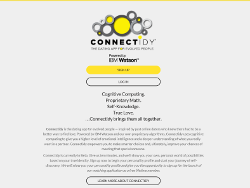
Human matchmakers have plied their trade for hundreds of years, but only in the 21st century could something like this exist. Meet Connectidy, a new app that uses IBM's Watson AI to improve the dating experience.

Connectidy bills itself as “the dating app for evolved people.” Powered by a mix of Watson and proprietary algorithms, the app promises to give you a higher level of emotional intelligence and a deeper understanding of what you really want in a partner. Connectidy hopes to empower users to make smarter choices and, ultimately, increase the odds of meeting that special someone.

How does it work? Connectidy analyzes what users write and, more importantly, how they write, then presents an objective personality profile. The assessment is based on the Big Five personality traits, commonly used by psychologists to describe the human personality: openness to experience, conscientiousness, extraversion, agreeableness, and neuroticism.

To create your profile, IBM’s Watson AI inspects written text pulled from any or all of your social media accounts. You will also be asked to answer a series of open-ended questions. Leveraging the Praescripto Engine, Connectidy then uses its patent-pending 5 pass algorithms to deliver a highly accurate personality assessment. The more you communicate with others, the better Connectidy understands you. Answer the questions thoroughly and the website promises a profile that is 90 percent accurate or better.

Connectidy users aren't just able to create more authentic profiles. They also develop a deeper understanding of their own personalities so they can find partners who best complement those traits. Connectidy reveals how your dating decisions affect an outcome, allowing you to weigh the impact and adjust accordingly.

When a match is made, the service acts as a go-between to make sure you're sending the most effective communication possible. Tone Analyzer, also powered by Watson, evaluates your messages to provide tailored advice on word choice and tone. A user who scored highly on the extraversion personality trait, for instance, will get different recommendations that someone Connectidy deemed to be more introverted.

The goal at the end of it all is simple: meaningful relationships. There are apps a-plenty for users who are into serial dating and hookups, but it's harder to make an effective service for finding real, lasting compatibility. Connectidy hopes to be that app.

According to the company's president, Dineen Tallering, “Connectidy’s mission is to say ‘goodbye.’ As part of our success, we will change the current system that pulls daters in and never lets them out. We want to help users find that special someone so we have built technology that truly can end the online dating merry-go-round.”

Is Your Grammar Holding You Back in Dating?

Communication
  • Tuesday, March 15 2016 @ 09:20 am
  • Contributed by:
  • Views: 2,233

Maybe you’ve heard the statistics, but if not – pay attention, and turn on your spell check. Correct grammar usage and spelling goes a long way when you’re online dating. In fact, according to recent studies by online dating site Match, bad grammar is one of the biggest turn-offs for men and women – a close second behind poor hygiene.

In other words, make sure you know the difference between "your" and "you’re" before you message a potential match.

Website Grammerly did its own collection of data regarding dating and grammar usage, and came up with some interesting findings. As it turns out, people aren’t only aware of grammar mistakes – they pay attention to the specific words you use, too. Some terms are more attractive than others when you’re writing messages or an online dating profile.

For instance, men who use the word “women” rather than “girls” in their messaging are 28% more successful at getting responses. And those who use the word “whom” correctly do even better – they are 31% more successful than those who use it incorrectly.

Men are a little easier on women overall, but there are certain phrases they don’t like. When women use the words “divorce,” “separate,” or “my ex” they receive 4% fewer messages than those who don’t. (So maybe save your dating histories for the actual date, ladies.)

Spelling can be a big deal too, at least for women. Guys – if you have just two spelling errors in your profile, you reduce your chances of a response by 14%. As for the ladies? Men just aren’t so picky – spelling errors don’t affect their chances of getting a response. (Which may explain why women make nearly twice as many spelling, grammar and punctuation mistakes in their messages and profiles than men---it doesn’t seem to matter as much!)

Some other fun stats:

  • According to OkCupid, women receive 17 times as many messages as men – which may explain why they can be picky, but don’t have to watch their spelling and grammar mistakes.
  • Both men and women rate grammar as more important than confidence in online dating.
  • Eighty-eight percent of women judge their dates’ grammar mistakes, compared to 84% who judge their dates by their level of confidence. For men, it was 75% and 69% respectively.
  • Men use 21.9% more words than women do in their responses to questions                regarding their online dating profiles.
  • Roughly 11% of American adults (24  million people) have used an online dating site or app

Bottom line: check your messages before you hit “send” – it could make a huge difference in your online dating success.

Dating App Lulu Becomes Part of Online Dating Service Badoo

Communication
  • Saturday, March 12 2016 @ 07:00 am
  • Contributed by:
  • Views: 2,633
Badoo Acquires Lulu

Lulu, a dating app designed to help women rate and share information about the men they date, has become part of online dating giant Badoo.

Lulu has had an interesting history. Founded in 2011 by Alexandra Chong, the app was originally created to help women have a safer online dating experience by encouraging them to communicate with other women over the app about the men they dated. Users were given the ability to rate their dates according to looks, humor, ambition, and even sexual prowess. They could also add pre-made hashtags for more detailed examples describing a man, like #OneWomanMan, #WillActSilly or #EpicLaugh.

This Word Could Be Ruining Your Chances Of Finding Love Online

Communication
  • Wednesday, March 09 2016 @ 06:47 am
  • Contributed by:
  • Views: 2,215

Could one word really be hurting your online dating game? Could one word make it better?

Dating app Hinge looked at 5,000 users who exchanged contact information within 24 hours of matching to determine which opening lines are most likely to get dates (and which will get you ghosted).

Using a text analysis model, they identified common phrases and words in the conversations they examined. So which words were winners and which words were losers?

The biggest flop was the word 'sorry.' Hinge users who included 'sorry' in an initial communication were a whopping 56% less likely to get a person's number. Next time you feel tempted to apologize for not responding sooner, take the “sorry not sorry” approach (just don't actually write it). You were busy and that's a good thing. Besides, not explaining yourself creates a teeny bit of intriguing mystery your date may be eager to solve.

Hinge's research also found that being vague and “wishy-washy” is a turn-off for potential dates. People who suggested dates in ambiguous timeframes like “this weekend” and “next week” were 40% less likely to score someone's digits. The more specific you can be, the better. After all, you matched with them so you must be interested in them – make it clear by arranging concrete plans, or answering with a simple yes or no.

At the other end of the spectrum, laughter proved to be irresistable. Hinge found that conversations that used words associated with laughing – like 'haha' and the ever-present 'lol' – had a 17% higher chance of ending in an exchange of phone numbers. It's not hard to believe when you consider how many people say a sense of humor is one of the most important traits in a partner. And what would flirting be without a little witty banter?

Unsurprisingly, compliments also had a positive effect on conversations, but one type of compliment in particular stood out. When a Hinge user told another user that they have a cool name, it increased the likelihood of getting their digits by 12.5%. Destiny's Child had it right: say my name, say my name (especially if it's to talk about how awesome it is).

Of course, no amount of dating advice or studies can guarantee a a phone number (much less a date), but they can help you avoid some basic mistakes. For more information on the dating app which brought us this study you can read our review of Hinge.

Page navigation