Studies

New Tinder Study Shows Men and Women Don’t Understand What Each Other Wants from Dating Apps

Studies
  • Thursday, June 06 2024 @ 02:17 pm
  • Contributed by:
  • Views: 1,093
Tinder Green Flag Study Results
Image: Tinder

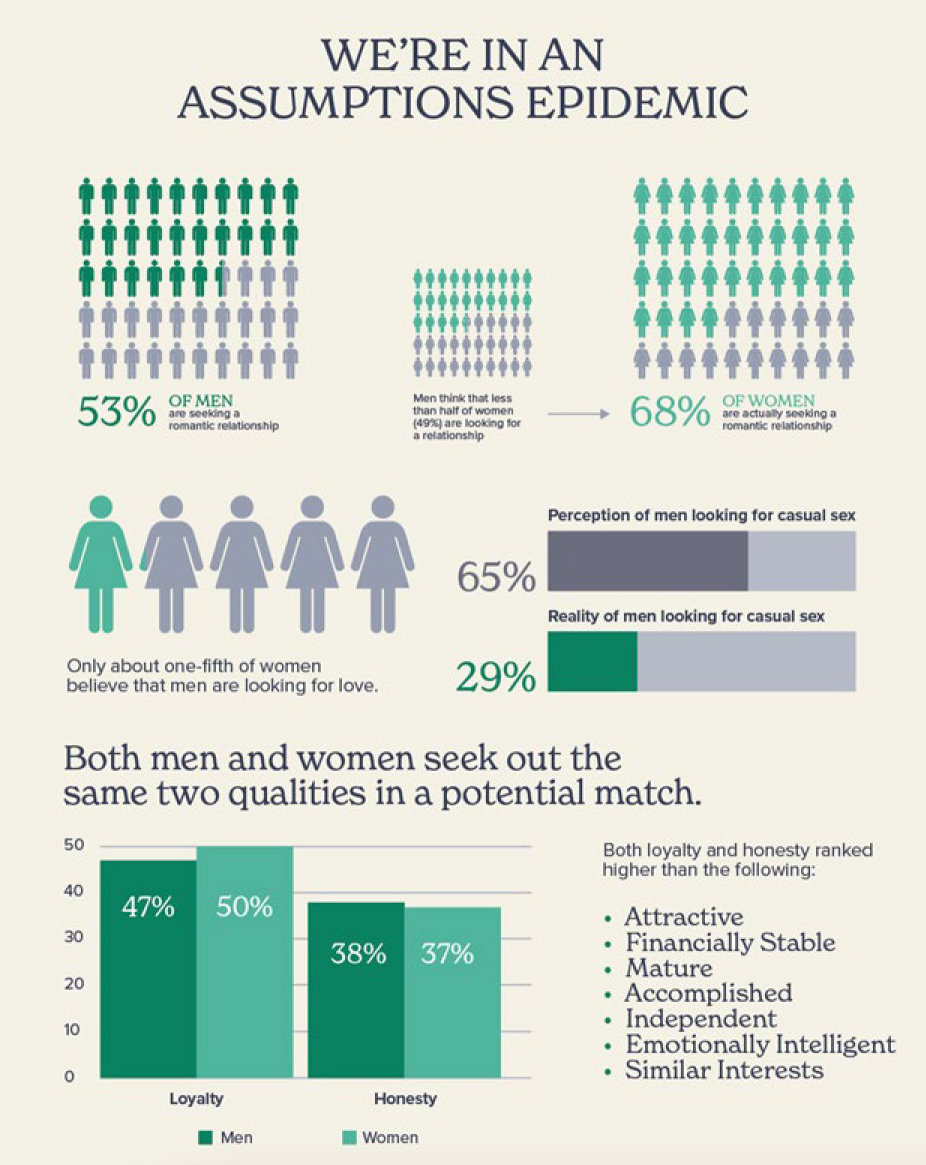
A new study by dating app Tinder shows that women and men have major misconceptions about what each other wants from dating apps.

According to USA Today, Tinder’s “Green Flags Study” polled 8,000 heterosexual men and women between 18-34 years old across the U.S., United Kingdom, Canada and Australia to see what people think of the opposite sex when it comes to using dating apps. Researchers pointed out that both men and women who identify as straight were quick to make assumptions about what others actually want out of Tinder, and turned out to often be wrong.

More than half of male (53 percent) and female (68 percent) respondents said they are seeking a romantic relationship.

New Study Finds Dating Apps Collect More Data Than Users Know

Studies
  • Wednesday, May 08 2024 @ 12:51 pm
  • Contributed by:
  • Views: 961

A new study from the research team at Mozilla has found that dating apps are collecting and selling more information than its users might be aware of.

According to The Washington Post, Mozilla found that 80 percent of the dating apps they reviewed – which include popular apps like Tinder, Bumble, and Hinge among others – may share the personal data of users with their advertisers. In fact, the privacy policies that users must agree with to use these platforms make it clear that their personal information could be sold. But how many are reading the fine print?

Spark Networks’ privacy policy was particularly specific and alarming for its apps JDate, Christian Mingle and Elite Singles. It stated that the apps might collect “sensitive information” including political affiliation, union memberships, and your “sexual preferences and experiences,” according to the Post.

Geolocation Sharing on Dating Apps Cause Privacy Concerns

Studies
  • Thursday, April 25 2024 @ 02:43 pm
  • Contributed by:
  • Views: 1,156
 Dating Apps Privacy Concern with Geolocation Data

Dating apps are adding geolocation sharing features to their platforms, but a new investigation found that it’s possible to identify the exact location of a user with stunning accuracy.

According to a new report from Mashable, a study by Checkpoint Research’s Alexey Bukhteyev found that trilateration can be used to find the precise location of a dating app user. Most dating apps use location filters to match people who are relatively close to each other, but trilateration can find the exact position of a user by measuring distances from multiple points, accurate to within a few meters. This technique can also circumvent privacy protections built into these apps.

Bukhteyev found this particularly worrying on LGBTQ+ dating apps, two of which were used in his investigation, according to Mashable. One of the issues is that in countries that don’t recognize the rights of LGBTQ+ people, local and government officials can locate and target dating app users with trilateration. Recently, officials in the Middle East were targeting people on gay dating apps, asking them to meet for a date, and arresting them when they arrived.

Study Finds That Disappearing Photos Increase Matches

Studies
  • Monday, April 22 2024 @ 12:56 pm
  • Contributed by:
  • Views: 1,119
Disappearing Photos

A new study has found that when dating app users can share disappearing photos with other users, it can increase matches and user engagement.

According to Phys.org, researchers found that enabling people to share photos that would disappear within a certain timeframe helped them overcome fears related to privacy and helped with conversation starters. Many dating app users are not willing to share personal details about themselves when they meet new people on dating apps, making it more difficult to connect and have deeper conversations, according to the study.

The large-scale randomized field experiment was conducted with more than 70,000 users of a China-based dating app. The experiment featured both a control group where subjects uploaded a photo that would stay posted, like in traditional dating app profiles, and a treatment group where users could upload ephemeral photos. They found that users in the treatment group sent more personal photos compared with the control group.

New Book Explores Algorithms and Sexual Racism in Online Dating

Studies
  • Wednesday, April 10 2024 @ 08:18 am
  • Contributed by:
  • Views: 724

Apryl Williams, Harvard sociologist and researcher who studies race, gender, and popular culture, has written a new book entitled Not My Type: Automating Sexual Racism in Online Dating.

According to Harvard News, the book is a blend of technical analysis, user interviews, and an “historical look at racism and romance in America,” and is a result of ten years of research.

Williams argues that algorithms in dating apps curate matches based on ranking attractiveness that is “racially informed.” In other words, algorithms match users with others who look like them, reinforcing racial stereotypes and feeding into the idea that certain groups are more attractive and appealing than others.

Despite Being Scammed Users Return to Dating Apps

Studies
  • Monday, March 18 2024 @ 11:42 am
  • Contributed by:
  • Views: 933

A new report on dating app security found that a majority of 70 percent of dating app users had been scammed on one of the dating platforms.

According to Newsweek, the study surveyed people who had used dating apps over the past three years, and 93 percent said they would go back to using the apps, even those who said they were scammed or had their information stolen.

When users sign up for these platforms, their personal information, even social security numbers, become vulnerable to scammers. Sixty-nine percent of those surveyed said they were asked to verify their identity on a dating app and 65 percent said they’d provided their social security numbers.

Page navigation