Marriage

Research Indicates Online Dating Is Creating Stronger, More Diverse Marriages

Marriage
  • Monday, November 20 2017 @ 05:09 pm
  • Contributed by:
  • Views: 1,321
Study of Marriage and Online Dating

Online dating has been accused of ruining romance, fueling hook-up culture, spreading STDs, promoting superficiality, undermining marriage, eroding traditional values, and that’s just a scratch in the surface of the critiques levied against modern matchmaking.

But for all the complaining we’ve done - and likely will continue to do - about online dating, it’s not all doom and gloom. Recent research suggests the rise of digital dating services could be behind stronger marriages, more connections between people from different social circles, and an increase in interracial partnerships.

Economists Josue Ortega at the University of Essex and Philipp Hergovich at the University of Vienna in Austria set out to examine how today’s tech-savvy singles are changing society.

Tinder, Hinge Holding Wedding Competitions for Users Who Meet on Their Apps

Marriage
  • Tuesday, July 04 2017 @ 07:44 am
  • Contributed by:
  • Views: 1,469
Wedding Contests by both Tinder and Hinge

Online dating companies are thinking outside the box, thanks to the flooded app market and growing consumer base. Popular dating apps Tinder and Hinge are now offering wedding competitions to users who meet through each of their respective dating apps.

Tinder announced that it would offer to pay $100K towards the cost of an LGBTQ wedding for a couple who met through the app. The move was a nod in honor of Pride Month in June.

Tinder launched a new feature last year to include “transgender” as a gender choice, along with almost 40 other options with which users can choose to identify. The company saw an additional 250,000 new matches made as a result of the inclusion, and now, they want to encourage one lucky LGBTQ couple to tie the knot. Tinder also discovered via a recent study that these users are more likely to want a serious relationship, rather than a hook-up. According to an article in Elite Daily, the large majority of gay users (66.4 percent) and lesbian users (62.1 percent) agree that using Tinder will lead to a long-term relationship.

Millennials Are Having Less Sex Than Previous Generations

Marriage
  • Wednesday, August 31 2016 @ 07:37 am
  • Contributed by:
  • Views: 1,690
Millennials Abstinence

New claims are made about Millennials every day. “Millennials are lazy!” “Millennials still live with their parents!” “Millennials are entitled!” “Millennials will never save money!”

Thanks to a recent study conducted at Florida Atlantic University, a new provocative headline has joined the generational narrative: “Millennials aren’t having sex!”

The study found that 15% of Millennials aged 20 - 24 said they had no sexual partners since turning 18. That’s more than twice the number (6%) of GenX’ers born in the 1960s who said they’ve had no sexual partners as adults. The shift toward higher rates of sexual inactivity among Millennials was particularly pronounced among women, and absent among Black Americans and those with a college education.

Match.com Study Reveals The Right Time To Say 'I Love You'

Marriage
  • Thursday, February 11 2016 @ 09:55 am
  • Contributed by:
  • Views: 3,475
Match.com Flowchart

From the first date, to the first kiss, to your first time between the sheets, every new relationship is marked by a series of milestones. Every one you reach is thrilling and nerve-racking, and daters have wondered since the beginning of time how to hack the system.

A new survey from Match.com attempts to answer the question of when it's the 'right' time to cross each milestone. More than 2,000 men and women in the UK were surveyed in attempt to map out the journey of the average (as much as any relationship can be 'average') long-term relationship. Here's what they found.

Within Two Weeks

The Match.com chart starts at the logical beginning: the first date. According to Match's research, the first kiss happens immediately. In the next one to two weeks, a budding couple will hold hands for the first time. They will also sleep together for the first time in that period, although they won't stay the night.

Within A Month

After the two-week point, things take a slightly more serious turn. A new couple will get undressed in front of each other – but only with the lights off – within a month. They will also introduce each other to their respective best friends.

Within Six Months

The relationship solidifies over the first six months together. Couples buy each other their first birthday presents and begin to call each other boyfriend and girlfriend. At five months comes one of the biggest milestones of all: saying 'I love you.' After that, the realities of a life together begin to sink in. Couples have their first argument around 170 days, reveal imperfections around 173 days, and introduce each other to parents before six months are up.

Within A Year

Couples become increasingly permanent fixtures in each other's lives during the first year. After six months have gone by, they are comfortable leaving toothbrushes at each other's bathrooms and having a drawer in each other's homes. Then comes the travel. At 204 days, they'll go away for a night together and at 298 days they'll take an entire vacation. Within a year, it's time to have a serious conversation about the future.

Over A Year

The biggest life milestones come after the one-year mark is reached. The average couple gets engaged at 743 days (around 2 years), gets a pet at 813 days, and buys a home together just before they reach three years. The average marriage comes at 1190 days, just over three years. Finally, the average couple has their first child together at 1422 days, after three years and 11 months together.

View the full flowchart from Match.com here and check our our Match.com review.

Match.com's 2015 'Singles In America' Study Smashes Stereotypes

Marriage
  • Wednesday, December 23 2015 @ 09:14 am
  • Contributed by:
  • Views: 1,310
Match.com Singles in America 2015

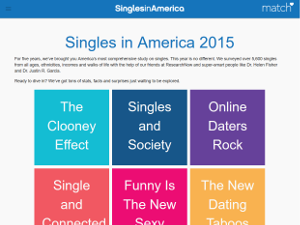
For half a decade, Match.com has celebrated dating with America’s most comprehensive study on singles. This year's annual analysis surveyed 5,600 singles from all ages, ethnicities, incomes and walks of life. What it found is a new dating landscape that's laying tired stereotypes to rest.

The days of macho men and dependent women are history. Men are increasingly seeking out independent female partners and women are setting the tone in relationships. The 'Singles in America' study calls it “The Clooney Effect.” According to the study, the majority of single women in 2015:

  • Want a partner with a sense of independence (89%)
  • Want a partner with the same level of intelligence (86%)
  • Think it's ok to casually date more than one person at a time (74%)
  • Are not willing to support a partner financially (55%)
  • Seek a partner who's comfortable with their sexuality (94%)
  • Would not likely date someone who's less intellectual (61%)

This Is How Online Dating Has Changed The Way We Love, According To Science

Marriage
  • Tuesday, September 08 2015 @ 06:50 am
  • Contributed by:
  • Views: 1,173

By now you've probably read – or at least heard about – Vanity Fair's recent takedown of online dating. The lengthy article is essentially an obituary for traditional courtship, which writer Nancy Jo Sales says is long gone thanks to online dating sites and mobile apps.

Tinder responded with a very public Twitter meltdown and tongues have been wagging about the state of modern dating ever since. Some agree with Sales, while others believe it's simply moral panic and anyone who hasn't jumped on the Tinder train is probably just too old to understand it.

The good news is, a growing body of scientific research is dedicated to online dating and the social change that comes along with it. The bad news is, even the scientists can't seem to agree with each other.

A 2012 study called “Searching for a Mate: The Rise of the Internet as a Social Intermediary” found no difference in relationship quality or strength between couples who met online and couples who met off. It also suggested that marriage and partnership rates may increase, as people with smaller pools of potential mates use dating services to cast wider nets.

Another 2012 study, headed up by Eli Finkel, concluded that most matching algorithms don't work. However, it also noted that “Online dating offers access to potential partners whom people would be unlikely to meet through other avenues, and this access yields new romantic possibilities.”

A 2013 study on marital satisfaction and breakups deemed online dating an unequivocally good thing. The research was sponsored by eHarmony, which rightfully has given some readers pause, but was reviewed by independent statisticians prior to publication.

A second study from 2013 examined sexual behavior and the “hookup culture” supposedly propagated by apps like Tinder. After examining a nationally representative sample of more than 1,800 18- to 25-year-olds, the study concluded that today's youth aren't substantially more promiscuous than previous generations. In fact, they may actually be having less sex than their predecessors.

Things got weird in 2014. Using the same data from 2012's “Searching for a Mate” study, a Ph.D. candidate at Michigan State came to the opposite conclusion about online dating and relationship quality. According to her findings, online daters are more likely to date than marry, more likely to break up faster, and more likely to break up more often.

How could two studies using the same statistics arrive at such different conclusions?

The answer is something we've always known: love is messy, contradictory, and confusing. Try quantifying that and you're bound to be disappointed.

Page navigation