
R. Luke DuBois Maps Out "A More Perfect Union"

- Tuesday, April 12 2011 @ 12:55 pm
- Contributed by: ElyseRomano
- Views: 2,849
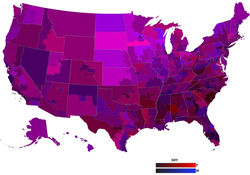
"Every ten years in the United States we take a census, the purpose of which is to determine how many people live in different areas of our country, so that the makeup of the House of Representatives reflects the makeup of the nation. Along with a simple count of heads, the census asks other questions which give us insight into our income, jobs, homes, ages, and backgrounds. This information is analyzed and published by the government, telling us who we are.
But these facts and figures, interesting and useful as they may be, are not really us."
With that interpretation of the U.S. census, artist R. Luke DuBois introduces his latest project, a piece entitled "A More Perfect Union." In an effort to define Americans more accurately and create his own version of the 2010 United States census, DuBois joined 21 online dating sites - from Match.com to AsiaFriendFinder - and analyzed the profiles of 19,095,414 single Americans. The results are "a road atlas of the United States, with the names of cities, towns, and neighborhoods replaced with the words people use to describe themselves and those they want to be with." The maps contain 20,262 unique words, each of which appears in the location in which it's used more frequently than anywhere else in the country.
DuBois found, among other things, that the nation's happiest people seem to be living on the coasts, particularly in Washington, where online daters in Seattle take the title for most instances of the word "happy" appearing in their dating profiles. The least happy women appeared to be living in New York, in the Bronx, while the least happy men call central and western Nebraska home.
Ladies in parts of Oklahoma, Florida, South Carolina, and Ohio - and men in parts of Texas, Wyoming, and Georgia - are the most "lonely" in the country. The least lonely women are in Illinois, and the least lonely men have settled in California, around Los Angeles.
Some of DuBois' more scandalous findings trace instances of words like "naughty," "virgin," and "kinky." No one in Wyoming, it turns out, uses the description "naughty" in their profiles, though many women in Colorado do. The highest concentrations of virgin men and women are in New York's 12th congressional district (which includes Williamsburg and the Lower East Side) and Louisiana's 2nd (New Orleans), respectively. New Orleans does, however, come in first when it comes to the least virgin men, an award that went to Houston, TX for the women. If kink is your thing, search San Jose, CA and southern West Virginia, which tied for most kinky women, or New Mexico for kinky men. Kinksters would do well, on the other hand, to avoid Wyoming completely.
Though DuBois doesn't theorize about why certain words are more prevalent in certain parts of the country, his experiment tells us a lot about what it means to date in contemporary America. "Online dating requires a very specific, complex act of self-identity," he told ABC. "If you don't do online dating, you assume everyone says the same thing, e.g. 'I'm nice, cute, smart, fun'.... But it turns out that the real objective of an online dating profile is to stand out from the crowd and get noticed, so people talk openly and honestly about their aspirations, their hobbies, their life history. It's really fascinating."
 Subscribe
