Studies

Most Couples Met IRL, Not Through a Dating App According to Recent Survey

Studies
  • Thursday, March 26 2015 @ 06:27 am
  • Contributed by:
  • Views: 2,618

Think you’ll have a better chance of meeting a new love through friends rather than Tinder? According to a recent survey by website Mic, you’re probably right.

Mic, a news website catering specifically to Millennials, decided to get to the bottom of dating apps and online dating to figure out how people in relationships are actually meeting. As it turns out, for all the buzz of Tinder – (and good news for the online-dating averse) – more couples have met through friends, work and in real-life social situations as opposed to over the Internet.

Mic surveyed more than 2,300 people between 18 and 34 years old, and it turns out, the vast majority of them – almost 39% - met their SOs through mutual friends, despite being part of the Tinder/ dating app generation. The next largest group – 22% of respondents - met through real-life social situations, such as at parties or bars. Eighteen percent met at work. When it comes to online dating, less than 10% of respondents met this way, and less than six percent met through social media. (Although to be fair to social media, this is quite extraordinary, considering it hasn’t been around nearly as long as online dating has.)

The latest Pew study reveals that online dating is gaining acceptance among the masses - 59% of Americans now believe that this is a good way to meet someone. But apparently, the majority of folks still aren’t meeting their next relationships that way.

There is a reason most people still prefer to meet through friends. Having the endorsement of someone you like and trust goes a long way, especially in the dating market where bad behavior is part of the experience. It’s like a little insurance policy against meeting someone – a total stranger - who might end up being hurtful or even dangerous.

This is evident in the dating app world, where meeting strangers online is commonplace. However, the fact that most apps have some type of verification through social media – for instance, requiring users to have a legitimate Facebook profile before being able to use the app – shows that there is a desire for validation before agreeing to a date. Some apps have taken this process a step further, connecting people online only through mutual social media friends (as with Hinge), or being an invitation-only app, such as with The League.

So what does this mean for the next generation of online daters? Dating apps and online dating are definitely here to stay – but it looks like the technology will keep gravitating towards mutual connections, either through social media or in real life.
Happy Couples Are Probably Just Tricking Themselves Into Believing They're Happy

Studies
  • Tuesday, February 24 2015 @ 06:24 am
  • Contributed by:
  • Views: 1,221

Here's a post-Valentine's Day reality check: happy couples may not be happy at all, just really good at deluding themselves.

Publications like Cosmo would have you believe that the secret to romantic success is seeing your partner as they truly are. And it does sound nice, but psychological research suggests it's the wrong approach. Instead, the key to a happy relationship is seeing your partner as you wish they were.

Just think about it for a second and suddenly it seems obvious: of course someone who believes their partner lives up to everything they've ever wanted is more satisfied with their relationship. How could they not be? Sure, they may be deceiving themselves, but can we say it's wrong if it works?

A study on the subject was published a few years back in the journal Psychological Science. A research team from the University at Buffalo and the University of British Columbia gathered together 200 couples who came to a courthouse in Buffalo, NY, to get marriage licenses. Then, twice a year for the next three years, the researchers questioned each person individually about themselves, their partners, and their visions of an ideal partner.

Afterwards, the answers were analyzed for certain patterns. The researchers sought out people who idealized their partners – those whose descriptions of their partner's traits matched their descriptions of their fictional perfect match (even if their partner did not self-report seeing those traits in him- or herself).

"If I see a pattern of traits that are more positive than what my partner says about themselves, that's what we mean by idealization," explains Dale Griffin, one of the study's co-authors. "That is, there is a correlation between my ideal set of traits and what I see in my partner that she does not see in herself."

Each time the researchers checked in with the couples, they also gave them a survey designed to measure relationship satisfaction. All couples reported a decline in happiness over time, but those who held positive illusions about their partners experienced significantly less of a decline.

The Psychological Science paper reports that “People in satisfying marital relationships see their own relationship as superior to other people's relationships” and that they also “see virtues in their partners that are not obvious to anyone else.” In fact, it gets even more extreme: “People in stable relationships even redefine what qualities they want in an ideal partner to match the qualities they perceive in their own partner.”

In other words, it's ok – and maybe even better – that love is a little blind.

Why Having So Many Choices Could Be The Worst Or The Best Thing About Online Dating

Studies
  • Thursday, February 05 2015 @ 06:45 am
  • Contributed by:
  • Views: 2,980

Too many cooks spoil the broth, but do too many dates spoil the romance?

People love online dating because it offers so many choices, including potential partners you may never have met otherwise. Falling in love with someone who lives halfway across the world was almost impossible before the Internet.

But all those choices could be making dating harder. Instead of making your life easier, online dating might be making it more stressful thanks to a psychological phenomenon called the “paradox of choice.” The more choices you have, the more difficult it is to actually make one. Instead we consistently feel unsatisfied with our choices, or simply refuse to choose at all.

Increased choice has been scientifically proven to cause anxiety and “choice overload,” which is exactly what you think it is. Your brain can become overwhelmed when faced with too many online dating profiles, causing it to misremember what it sees in each. It can also cause you to make decisions that are less than optimal, and settle for partners who don't match your own stated preferences.

And let's not forget about the time factor. Online dating is a notorious time-suck, and it gets worse the more options you have. A 2009 study found that "more search options triggered excessive searching," making it harder for participants to weed out incompatible options and hone in on what they really wanted.

The famous experiment that tested the paradox of choice was conducted by Columbia University professors in 2000. Grocery store shoppers were presented with 6 jam samples on one table and 24 on another. More customers visited the table with 24 choices, but fewer actually purchased from it. That means that while we are initially attracted to having many options, we find it more difficult to choose when actually presented with them.

Online dating is a table full of thousands and thousands of jams. The variety is endless and the supply is bottomless. It's hard to decide what's going on your toast under those circumstances, and the end result is apathy.

But there's hope. Other research has found that, under the right circumstances, more options can actually make you more certain of your choice by heightening the distinctions between possibilities. Online dating allows you to get hyper-specific about what you want, meaning you can narrow down your options to maximize effectiveness.

In the end, the real benefit of online dating sites is a little bit of both. By getting hyper-specific, they put the most relevant, compatible people directly in front of you. And by offering so many choices, they also leave open the possibility of meeting someone you didn't even know you were looking for.

Is There Such a Thing as too Much Choice?

Studies
  • Monday, February 02 2015 @ 06:20 am
  • Contributed by:
  • Views: 1,300

Online dating is evolving along with daters’ preferences. We have grown used to the idea of using technology for our personal lives, with more people online dating than ever (thanks to the rise of dating apps like Tinder).

The dating landscape has changed, even in the last few years. There is new technology of course, but there is also the growing number of singles (which consist of more than half of U.S. adults over age 18), and the fact that young adults are waiting longer to marry. So college isn’t the place you’re likely to meet your life partner – instead, it’s more likely going to be online.

With so much changing and so many singles out there, why is it still so hard to find the right person, or even to get a date from a few back-and-forth texts?

The answer might be simpler than you think. There have been several studies in recent years about our ability to make decisions, especially when we are given a lot of choices. Much like wandering into a candy store when you just want a bite of something sweet, your mind can be immediately overloaded with all the different types, brands, and flavors – so that you almost become paralyzed by the choices and unable to make a decision.

A study was conducted a few years back, where a group of people were given a choice between a few different brands of laundry detergents and asked to pick which one they’d buy. With only three or four choices, they tended to read the labels of ingredients and decide which was best based on content. They were also generally pleased with their choices.

The next group was given dozens of choices of laundry detergent. Researchers discovered when there were more than a few choices, people didn’t take any longer in making a decision - they were too overwhelmed and didn’t read the labels at all. The majority chose which detergent they would buy based solely on what the container looked like, and didn’t look at the ingredients. In fact – they were basing their decisions purely on superficial “looks,” because it was easier than trying to get to know all of their choices.

It’s no wonder we feel a bit ADD when it comes to dating, and that apps like Tinder have taken off. When we are given too much choice, it’s easier to just look at the photo and make an impulsive decision – yes or no - rather than think about what we really want. We don’t get to know people before deciding we aren’t interested in a date or even a drink. It’s too easy to think “there’s probably someone even better” while we are swiping, so we don't think twice about standing someone up or refusing to text them back.

Maybe it’s time to focus on one date at a time. Maybe we should start saying yes more often - instead of no.

What Men Notice on a First Date

Studies
  • Saturday, December 13 2014 @ 10:11 am
  • Contributed by:
  • Views: 1,758

Are you online dating? Having a hard time getting to date number two? If so, there are a few things you might not have considered when you’re meeting someone for the first time. With online dating, your friends can’t give you the inside scoop on a total stranger like they could a mutual friend. So it’s best to approach each first date understanding he knows nothing about you – not your sense of humor, your thoughtfulness, your body image. Nothing. Your profile doesn’t reveal nearly enough.

So, it’s your job to take nothing for granted, and try to see yourself through his eyes. He could be paying attention to things you don’t even think about, or that aren’t your priority. And that’s where a lot of misunderstandings come into play.

Guys do pay attention on dates, and they are looking for cues that you’re interested. Following are some things that they notice (and no, it’s not your cute outfit or new heels), based on a survey taken by Women’s Health Magazine:

If you’re on time. Many guys hate waiting on their dates to arrive when they have made an effort to be on time. If you’re late because you’re afraid of looking too eager, you could be missing out on some great guys who think that you don’t care enough to be punctual or let them know you’re running late.

Breaks in conversation. Some guys pay attention to what you do when the conversation pauses. Are you looking around, acting bored? Or are you giving the conversation thoughtful attention? Are you shy, or just thinking of the next clever thing to say? Guys pay attention to your body language as much as anything you say.

If you reach for your purse. Most guys don’t have an issue with paying for a date, but they do appreciate it when you offer.

If you are rude to servers, valet, etc. Maybe you are fun, engaging and warm with your date, but if you start treating waiters or bartenders with attitude, guys will notice. This is a big turn-off.

Your smile. Guys like to know if you’re having fun. Smiling is a sign that you’re comfortable and enjoying yourself. Try to keep an open mind - when you go into the date having an attitude or chip on your shoulder, it’s not sexy.

Attraction/ chemistry. Guys are blunt – they do look at you. They want to know if you look like your pictures, and if they feel a physical attraction. They want to feel a spark of chemistry in order to pursue you. So don’t take it personally if you’re not everyone’s cup of tea. Studies have shown that guys have a wide range of physical tastes – so don’t let one or two rejections stop you from meeting new people. Emphasize your attributes, don’t shy away from being who you are. That is sexy.

Map Shows Your State’s Favorite Word To Use In Online Dating

Studies
  • Friday, December 12 2014 @ 06:21 am
  • Contributed by:
  • Views: 1,616
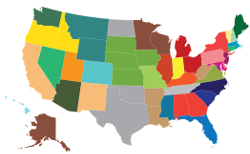
United States Map

How much do people in Indiana love auto racing? So much that NASCAR is the most frequently used word in online dating profiles from the state.

Mashable recently teamed up with Match.com to analyze thousands of US-based online dating profiles and discover how daters differ from state to state. Anyone who ventures into the untamed wilds of online dating quickly discovers the same words and phrases appear over and over again. Surprise: it turns out that pretty much everyone likes all music except country. Yawn.

Tired of feeling like all online dating profiles are the same, Mashable and Match broke down which words are used with relative frequency in certain states, compared to relative frequency in the rest of the country. If you're in the mood for making the most cliché online dating profile possible, find your location on this map and see what daters in your state are most obsessed with.

Here are a few highlights:

  • California: desert
  • New York: museum
  • Texas: oil
  • Florida: Disney
  • Alaska: cabin
  • Georgia: grilling
  • Hawaii: surf
  • Nevada: casino (duh)

Match and Mashable aren't the only ones who recently delved into state-by-state dating. The dating app Lulu (think Yelp, but for ranking and reviewing men) did some research to find out who the most popular man in each state is. Female Lulu users can anonymously rate men they know on everything from looks, to ambition, to relationships. to, yes, sex. Lulu also recently introduced anonymous messages and questions called "Truth Bombs.”

As you can probably imagine, the app was controversial when it first launched, but Lulu has since cleaned up its image and allowed men to sign up for the service. They can’t rate women, but they can promote their profiles.

The men in this experiment (all Lulu users themselves) were rated on a scale of 1-10 by women who know them. Business Insider reports: “While there are no perfect scores in the US, a man in Texas and a man in Illinois men both received a 9.7 score. Their friends used the following hashtags to describe them: ‘#DoesDishes,’ ‘#RemembersBirthdays,’ and ‘#OneOfTheGoodOnes.’”

All descriptions in Lulu are hashtags, because longer free-form answers could earn the writer an accusation of libel. Some of the top hashtags include #OpensDoors, #CaptainFun, #MakesMeLaugh, #RespectsWomen, #AlwaysHappy, #CanTalkToMyDad, #NerdyButILikeIt, and the simple but effective #NotADick.

For a full list of the winning men, see the original post on Business Insider. For more on one of the dating services that conducted the study please read our review of Match.com.

Page navigation