Free

Coffee Meets Bagel Secures $7.8 Million in Funding

  • Friday, February 27 2015 @ 06:29 am
  • Contributed by:
  • Views: 2,017

Coffee Meets Bagel has been overshadowed by its more aggressive competitors (like Tinder), but lately has emerged as a serious, lasting contender in the dating app space. The company is showing its app has real growth potential by securing $7.8 million in a Series A financing round led by existing investor DCM Ventures. Quest Ventures and Azure Capital also participated in the round.

This round of financing is followed by the steadily growing success of an app whose founders like to take things slowly, testing what works in each market (starting with its launch in 2012 to New York and Boston markets) before moving on to the next. Recently, the company expanded from an iPhone-only app to include an Android app as well, opening markets further.

Coffee Meets Bagel sets itself apart by making the dating app experience feel more personal. People are connected through their social networks – through mutual friends on Facebook, for instance – so there is a level of assurance that you can avoid the scammers and fake profiles. Also, CMB users receive only one match per day, avoiding the whole Tinder hook-up potential. Each day, users have 24 hours to message their match, and then a week to set up a date before they vanish into the ethers. The point is to keep the conversation going, instead of just letting messages and matches accumulate while users see who else is out there.

While the design is game-like (you can get “coffee beans” by providing information or referring friends to the service, which in turn can be used to access additional features, like the ability to see who your mutual friends are, or to rekindle the flame with a match you neglected to message in time.) The company also teamed up in certain cities with local businesses to offer discounts to places you could go for a first date, although the growth of the app nation-wide has prevented them from doing this in more than a few major cities.

The additional funding will pay for engineers and developers to help build the core business so it can handle the projected growth in users. While the company hasn’t publicly shared their subscriber figures lately, the interest from investors is telling.

CMB has been compared to dating app Hinge and Are You Interested, which also focus on matches based on mutual social media connections.

The additional financing follows the company’s earlier participation in the TV series “Shark Tank,” where the founders proposed their business plans to celebrity investors in the hopes of gaining additional funding. While they didn’t get it from the TV show’s panel of judges, they have been successful in raising the funds elsewhere.
Tinder co-Founder Launches New Dating App Bumble

  • Sunday, February 22 2015 @ 09:44 am
  • Contributed by:
  • Views: 1,875

For those who have been following the trajectory of the phenomenal success of dating app Tinder, for the founders of the app, it wasn’t such a successful match.

Whitney Wolfe was one of the founders of Tinder along with Justin Mateen and Sean Rad, who were the face of the company  as it launched to great success. Then Wolfe and Mateen became romantically involved and when that ended, so did their professional relationship – through reports of abusive behavior and a lawsuit that ended in a $1 million settlement for Wolfe.

The young entrepreneur wants to put all that behind her however. In a recent interview with Business Insider Australia, she addressed the lawsuit, her critics, and the launch of her new dating app Bumble.

Wolfe claims she has moved on, but her history with Tinder is still a bit convoluted. According to Wolfe, she came up with the name and first shepherded the dating app herself by reaching out to students on college campuses, urging them to try it. However, Mateen and Rad have stated that Mateen was the one who brought Tinder to potential users, mainly through the fraternities and his contacts with large social networks at college campuses.

The fight between Mateen and Wolfe got nasty, with text messages back and forth that were exposed in the media. From an outsider’s perspective, neither one of them looked innocent, but in the end, it was a case of he said she said.

Wolfe took her experience at Tinder and decided to try her hand in launching her own female-friendly dating app called Bumble. Although it has the same user-friendly photo-based structure and ease of Tinder, Bumble encourages women to make the first move by giving them 24 hours to reach out to a match before he disappears. (The guys have to sit back and wait for the women to message them.)

Other female-friendly dating apps have come before Bumble with their own spin – like LuLu, which allows women to rate their dates and discuss them with other women on the app. There’s also JessMeetKen, which allows women to promote one of their single guy friends to other women on the site, in order to give them a little endorsement for potential dates. But Bumble is showing promise too, with Wolfe reaching out to college students and encouraging them to give it a try.

“We’re definitely not trying to be sexist, that’s not the goal,” Wolfe told Business Insider. “I know guys get sick of making the first move all the time. Why does a girl feel like she should sit and wait around? Why is there this standard that, as a woman, you can get your dream job but you can’t talk to a guy first? Let’s make dating feel more modern.”

According to Wolfe, 60% of matches on Bumble turn into conversations, and in a little over a month since the launch, there have been more than 100,000 downloads. 

High There – A New Dating App for Weed Lovers

  • Friday, February 20 2015 @ 06:32 am
  • Contributed by:
  • Views: 2,896
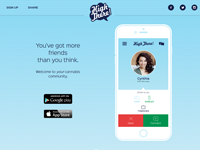
High There Dating App

It was only a matter of time before a Denver-based app developer would take advantage of the city’s new legalized pot industry. High There! - a new dating app specifically for weed lovers, launched this month for Android and will be debuting in the iTunes store soon. In addition to the mile-high city, the app is also available in 23 states that have legalized medical marijuana laws.

High There has been described as “the Tinder of pot smoking,” although instead of matching according to proximity and age preferences, the app asks for your weed preferences, such as vaping or smoking, and what your energy level is when you are imbibing – “low energy couch potato or high energy explorer,” according to a report on Mashable.

The design of the app is similar to Tinder, with photos as the main feature and the ability to accept or reject a match by swiping left or right. Besides how you consume your pot, a few extra questions are added to enhance your profile, including what you are in the mood for – “go out, stay in, or chat?” and your interests (“culture, outdoors”).

CEO Todd Mitchem says he was inspired to create the app after his date called it quits when she found out he smoked pot. It wasn’t the first time it had happened, so he decided he’d rather only date pot smokers – but needed a way to meet them. He wanted to build a community around people who might otherwise feel shunned for their habit. He told Mashable that the app “can also act as a kind of social network for smokers who are seeking recommendations on local dispensaries, to share tips or just make friends with other like-minded folks.”   

High There however is not the first dating app to cater to this particular clientele. My420mate launched last year, and 420Singles has been offering their pot-friendly app for a while as well, though High There seems to be getting a lot more attention in the press.

So far, the reception to High There has been mixed, according to reviews in the app store. The main reason for users’ frustration is that they download the free app and then can’t use it because of the marijuana laws in their particular cities. (If it isn’t available to purchase legally in your town, you can’t use the app.) Many people complain that they do have medical marijuana cards from another city, but can’t use the app because of the legal status in the city where they live.

High There is free and available for Android users, and will soon be available for download from the iTunes store.

Tinder Looking for Revenue Through Product Tie-Ins

  • Monday, February 09 2015 @ 06:30 am
  • Contributed by:
  • Views: 2,116

By now, most people have heard of Tinder, whether or not they have used the dating app or understand what it does. Tinder has become a brand synonymous with modern online dating. But since its launch in 2012, the company has been struggling with taking advantage of its explosive popularity and translating it into revenue. After all, the dating app itself is free – a major draw in the online dating world for people who just want to try it out, and one of the factors contributing to its success. But offering a free service doesn’t help the company build its business.

In the last few months Tinder launched a premium service called Tinder Plus, charging users for special features like searching for matches in another city, a pretty typical revenue path for online dating apps looking first for an audience and then for ways to generate revenue. But since Tinder has garnered brand recognition, the company has decided to use this to its advantage by partnering with other well-known brands. With product placement for TV shows and advertising campaigns featuring young single daters swiping left and right, Tinder is charging companies to be seen with its brand – specifically companies trying to appeal to a younger demographic.

For instance, last year Tinder was featured on The Mindy Project to help its main character find a new boyfriend, and Domino’s pizza created a Valentine’s Day advertising campaign offering deals to Tinder users. But the dating app’s latest tie-in is getting some buzz. Tinder teamed up with Gillette to analyze 100,000 male Tinder users – with facial hair and without – to see if women swiped left or right more often for the clean-shaven guys. The results? It seems Gillette won, with a vast majority – 74% of total right swipes going to the well-groomed guys - as well as 37% more matches.

Gillette put together a 30-second spot outlining the study and its results, showing groups of single women on their Tinder apps, swiping left (rejecting) guys with facial hair and then swiping right (accepting the match) for the same guys once they were clean-shaven. The women were also shown commenting on which guys looked better without facial hair.

Gillette is promoting the test results on a website called shavetest.com, as well as through YouTube. Of course, the main idea is that guys would rush out to purchase Gillette products so they can score more dates. But really, it seems the winner is Tinder, with more well-known brands trying to capitalize on its popularity and reach consumers where they are – on their phones.

How to Handle Those Unwanted Messages

  • Monday, January 26 2015 @ 06:34 am
  • Contributed by:
  • Views: 1,837
Bye Felipe

The rise in popularity of Bye Felipe isn’t accidental – it’s due to more and more women speaking out about unwanted or even abusive messages they receive through dating apps and online dating sites.

Online dating has become mainstream, thanks to the rise in popularity of dating apps like Tinder, which have made it easier to meet people now more than ever. However, along with all of these new opportunities (and new people joining the game) come some unwanted messages and trolls looking for a platform to vent their anger rather than connect with someone.

Most of us (especially women) have been subjected to some unwanted or even abusive behavior online. We receive messages propositioning for sex without even meeting face-to-face first, or abusive messages claiming that we are untrustworthy, shallow, ugly, etc. from men we’ve only exchanged a couple of text messages with. This can be shocking, hurtful, and even scary – turning many victims off of online dating altogether.

It’s only natural for online daters to wonder what exactly they are signing up for when they experience this kind of abusive behavior.

Unfortunately, because some people are skeptical of the effectiveness of online dating, a few abusive emails are enough to write off the whole practice. But this is the wrong approach. It’s better instead to look at online dating as a whole, rather than just its worst aspects (and worst customers).

Instead of looking at all the online connections that are positive (or even ordinary), we tend to focus on the messages that have been upsetting, suggestive, and otherwise unwanted. We dwell on the negative, confirming our fears about meeting people online. But the truth is, millions of matches are made every day with no abuse, and no fanfare either. The vast majority of matches are between ordinary people looking for real-life relationships. If we get caught up in the actions of a small percentage of trolls, we miss opportunities.

We should not ignore the problem. Clearly, online dating sites have to clean up the process to be able to filter out this kind of bad behavior. A lot more work needs to be done.

But if you want a chance to meet people outside of your current networks of friends, family and co-workers, online dating is your best opportunity. But be smart in your approach. Research different websites and apps. Obviously apps like Tinder are very popular, but that means they also attract a lot of dating trolls. If you are looking for something more serious, you might want to invest in a site like eHarmony where there is more of a screening process among users.

Don’t give up on online dating because of a few bad apples. Give it another chance. Try a new site. Ask your friends to help. These small steps should help you improve your overall experience. For more information on the services mentioned you can read our Tinder review and our eHarmony review.

Only 1% of Tinder Users Find a Match

  • Thursday, January 08 2015 @ 06:30 am
  • Contributed by:
  • Views: 7,301

If you are among the 150,000 Tinder users in Ireland, your chances of finding a match are only one in a hundred - or about 1% - according to a new study.

Researchers for Ipsos MRBI, who surveyed people living in Ireland who say they use Tinder, discovered that dating app users’ chances for finding someone they click with are not that much greater than randomly meeting people at bars and pubs. In fact, the odds may be less favorable with apps, likely because there is the perception of browsing through a seemingly infinite number of eligible singles each time you log on to the app, making commitment seem unappealing. The more choices you have, the less willing you become to settle for just one person.

There is an addictive quality to apps like Tinder, according to its own figures. The average Tinder user spends between an hour and 90 minutes using the app every day, logging in 11 times. There are also an estimated 50 million active users of Tinder, compared to 864 million active Facebook users and 300 million active Twitter users – proving that the dating app has as much power to hold users’ attention as the major social media platforms.

Part of the reason for its low percentage of matches might be Tinder’s demographic, at least in Ireland - preferred mainly among fickle twenty-somethings who log on to the app several times a day. Only 12% of Irish Tinder users are between ages 35 and 44, and for those between 45 and 54, the number goes down to 3%.

Men are also less picky than women when it comes to saying yes to a dating app match. According to the study, they are three times more likely (46%) to swipe “like” on a woman’s profile whereas only 14% of women say yes to a man’s profile. The study also shows however that women invest a little more thought and time - women spend 8.5 minutes reading profiles on Tinder each time they log in, compared to a man’s 7.2 minutes (which are spent swiping).

So what does this mean for daters? The U.K. might not be much different from Tinder users all over the world. There is an accessibility and ease to the app, which has made it extremely popular and given its users a lot of options when it comes to meeting new people. But just like flipping through magazine pictures, sometimes it’s easier to just look at more photos than to reach out and contact someone, even if you find them intriguing. The real test is – can Tinder translate to real-world relationships?

Maybe your chances are about the same on Tinder as they are at your local bar. But until you reach out to try and meet in real life, you won’t know.

Page navigation