Tinder Launches Face to Face Video Chat Feature
Contributed by: kellyseal on Friday, August 28 2020 @ 08:06 am
Last modified on Friday, August 28 2020 @ 09:03 am

Popular dating app Tinder launched its new in-app video chat feature in early July called Face to Face, but only in select markets.
Face to Face users have access to video call each other through the dating app and avoid exchanging personal numbers, which is a good step for overall user security. There are a few other privacy measures that Tinder is including in the rollout – namely that two people have to agree to a video chat before it can actually happen, according to The Verge[*1] .
Only after a conversation gets going will the video icon enable in the right corner of the message screen. Users interested in a video call can then tap on the video icon to begin the process, according to Tinder’s website[*2] . From there, they are prompted to opt-in to video calls with that person. Only after both users opt-in can they video chat with each other, and they are able to opt-out anytime.

There’s another security layer before the call can happen: both callers have to agree to keep the call free from nudity and sexual content, and they cannot reference hate speech, violence, or illegal activities, according to The Verge.
The screen itself is split so each user can see themselves and the other person in identical frames without resizing the image or otherwise manipulating the visuals, providing a standard of control over the experience.
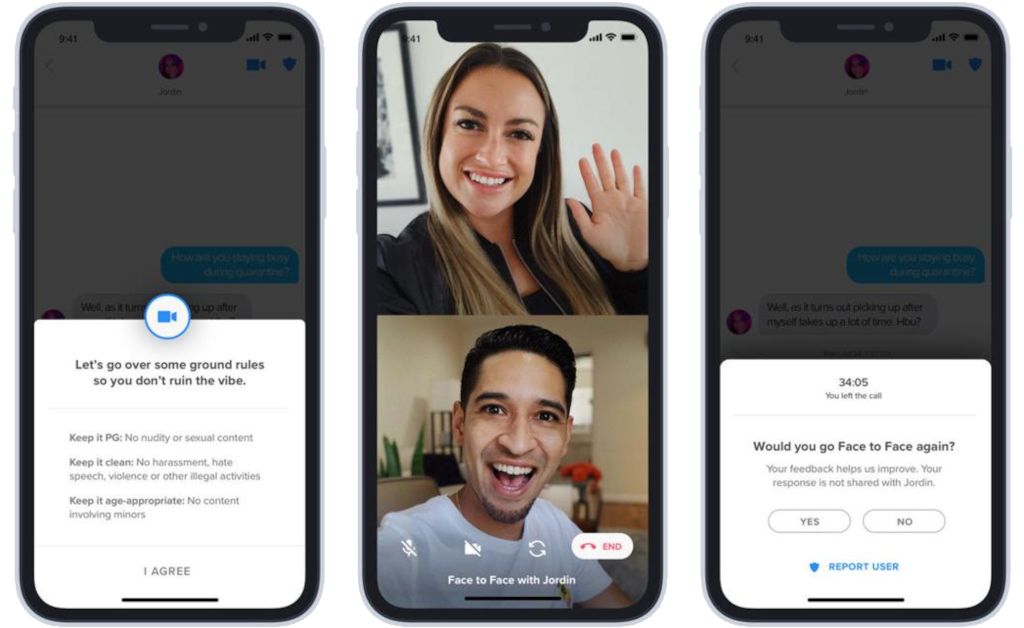
Once the call is over, each user will be asked if they would do another call, and are given the opportunity to report any inappropriate behavior. As of now, Tinder is not monitoring or recording these calls, but rather relying on user feedback. The company says it has “no intention” of recording calls in the future, citing user privacy.
“Nothing could happen in a call like this that couldn’t happen in any other call,” Rory Kozoll, the head of trust and safety product for Tinder, told The Verge. “So our perspective on it is that we would handle this the same way as if you had had a call through some other app or through your own phone with the person and you reported them to us.”
The Verge points out a concerning problem among trans Tinder users, who are more often reported by male users of the app who are targeting them because they are trans. Several trans users have been unfairly banned as a result. It’s likely these same issues will occur with Face to Face, and harassment might be at a more problematic level because technically Tinder can’t block screenshots or screen recordings of calls on iOS, though the company says they are working on a solution.
Currently the launch is being tested in 13 countries including Australia, Brazil and France - and only a few states in the U.S., including Virginia, Illinois, Georgia and Colorado. Tinder is seeing how the feature performs and what technical issues arise (like server capacity) before rolling out more widely.
For more on this dating service you can read our Tinder app review.